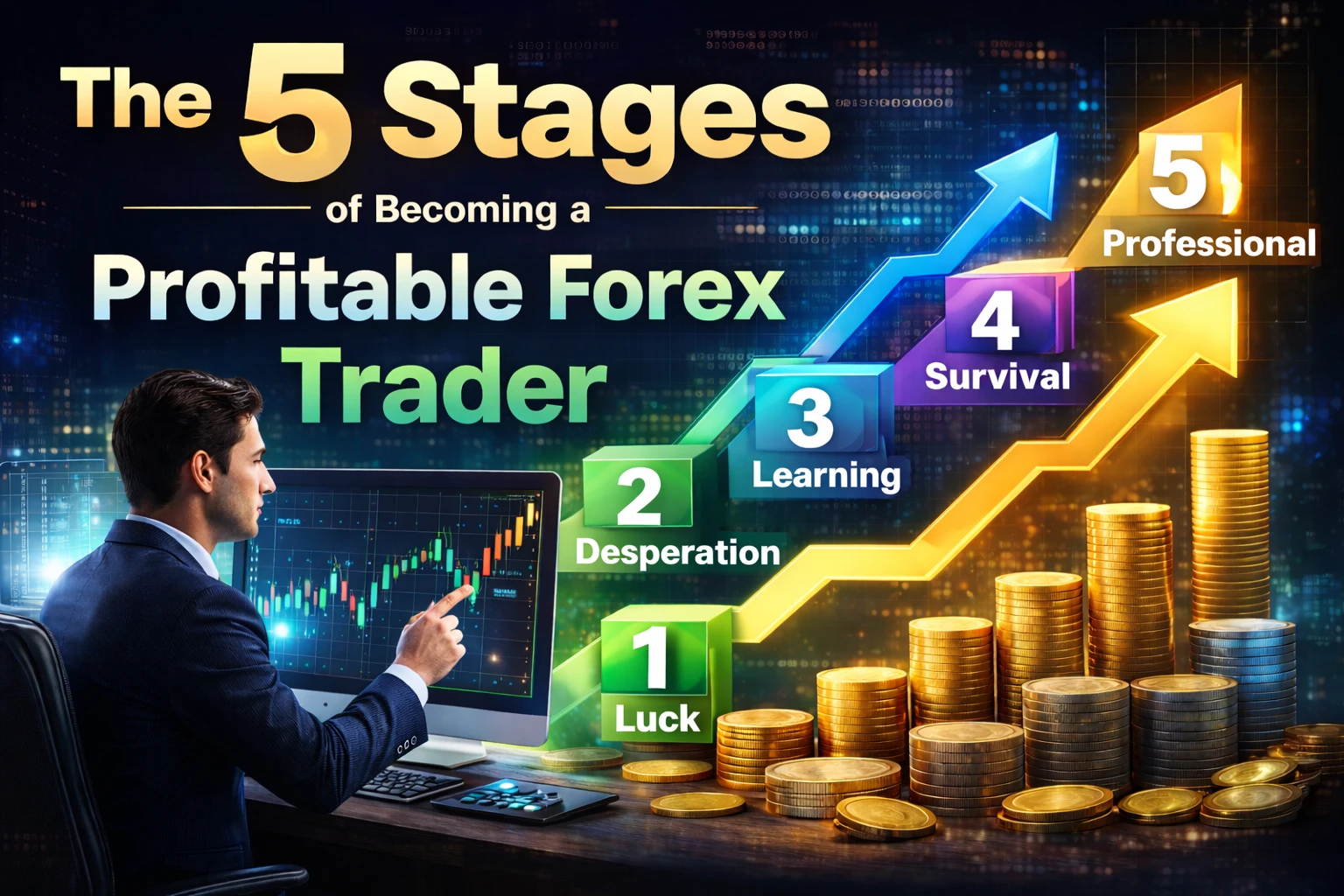
The 5 Stages of Becoming a Profitable Forex Trader: A Realistic Journey from Beginner to Professional
Fri Feb 20 2026
Many people enter forex trading after watching social media videos showing luxury cars, large profits, and financial freedom.
But the real journey of becoming a profitable trader is very different.
In reality, trading is a skill-based profession built on risk management, psychology, and consistency — not luck or lifestyle marketing.
Every trader passes through psychological and technical stages. The key is understanding which stage you are currently in and what you must improve to move forward.
This article explains the 5 stages of a trader’s journey — what happens in each stage, why it happens, and what serious traders should learn.
Stage 1: The Luck Phase (Trying Your Fortune)
This is where most traders begin.
a) What Happens?
- Traders enter the market expecting quick profits.
- Early trades sometimes win due to random market movement.
- Confidence increases quickly despite limited understanding.
- Traders start believing they have discovered a profitable strategy.
For example:
A beginner deposits $500. In the first week, they make $300 using high leverage.
They believe: “I understand the market.”
Then one large trade risks 20–30% of the account. The market moves against them, and they lose $400 in one trade — wiping out most gains.
b) Why It Happens
The forex market is probabilistic. Even random trades can win in favorable conditions.
But beginners mistake short-term luck for skill.
When losses come, many say:
- The market is manipulated.
- Brokers hunt stop losses.
Instead of reviewing mistakes, they blame the market.
Industry data from many regulated brokers shows that 70–80% of retail traders lose money, primarily due to poor risk management and overleveraging — not because of manipulation.
Around half of new traders quit during this stage.
c) What Traders Should Learn
- Short-term profit does not equal skill.
- Risk management is more important than winning trades.
If you are new, this is where understanding how the forex market works becomes essential.
Stage 2: The Desperation Phase (Trying Everything to Win)
After experiencing losses, many traders become desperate to recover money.
a) What Happens?
- Traders start switching strategies frequently.
- They buy multiple courses or follow many mentors.
- They jump between indicators and systems.
The focus is still the same:
Profit first. Understanding later.
b) Why It Happens
Loss creates emotional pressure. Instead of studying:
- Traders search for a “secret strategy.”
- They believe someone else has a shortcut to profits.
Traders search for a “perfect strategy.”
But no strategy wins 100% of the time.
For example:
A trader tests 5 strategies in 3 months. Each strategy loses 3–4 trades in a row. They switch before understanding long-term probability.
The problem is not the system. The problem is lack of discipline and data collection.
Many traders quit here because they believe “nothing works.”
c) What Traders Should Learn
- There is no secret strategy in trading.
- Consistency matters more than constantly changing systems.
- Emotional control is essential for long-term survival.
This is a good stage to deeply study risk management in forex trading.
Stage 3: The Learning Phase (Seeking Knowledge)
This stage marks a serious turning point.
Instead of chasing profits, traders begin chasing knowledge.
a) What Happens?
- Traders start studying market structure and technical analysis.
- They learn about probability and risk management.
- They begin testing strategies instead of randomly trading.
However, this stage has its own trap.
Some self-proclaimed mentors:
- Sell expensive courses promising guaranteed profits
- Present trading as an easy path to wealth
- Focus more on marketing than real risk management
It is important to understand:
No mentor can make you a profitable trader.
A mentor can:
- Teach trading concepts and market structure
- Share experience and common mistakes traders make
But only you can:
- Develop the discipline to follow a trading plan
- Control emotions during wins and losses
- Execute trades consistently according to your system
Many traders quit here because they think: “I learned everything. Still not profitable.”
The missing element is execution under pressure.
b)What Traders Should Learn
- Understanding a strategy is not the same as executing it.
- Consistency matters more than constantly searching for new systems.
Keeping a trading journal helps identify patterns such as:
- Emotional decisions after losses
- Breaking trading rules during volatile markets
- Entering trades without clear setups
Stage 4: The Survival Phase (Building Your Own System)
Now trading becomes more structured.
a) What Happens?
- Traders begin testing strategies more carefully.
- Risk management becomes a priority.
- Position sizing becomes more controlled.
But live markets introduce reality:
- Emotions affect decision making.
- Spread and slippage impact real trade results.
For example:
A backtest shows 60% win rate with 1:2 risk-reward. But in live trading:
- Traders exit trades early due to fear.
- Traders hesitate to enter valid setups.
Now performance drops.
b) The Big Realization
A strategy is like a car engine.
But you cannot drive with only an engine.
You also need:
- Risk management
- Psychological discipline
- Consistent execution
In this stage:
- Traders begin focusing more on consistency than quick profits
- Risk per trade becomes controlled and structured
- Emotional reactions during trades start reducing
- The trading plan becomes clearer and more disciplined
This is where traders begin to survive long enough to gain real experience.
Stage 5: The Professional Mindset (Trading Like a Business)
Very few traders reach this stage.
This is not about becoming rich overnight.
This is about maturity.
a) What Happens?
- Trading decisions become systematic rather than emotional.
- Traders follow predefined risk management rules.
- The focus shifts from quick profits to long-term consistency.
For example:
If you risk 1% per trade and aim for 1:2 risk-reward:
- Trade 1 — Loss (-1%)
- Trade 2 — Loss (-1%)
- Trade 3 — Win (+2%)
- Trade 4 — Loss (-1%)
Even with fewer wins, you can remain profitable.
Professional traders understand:
- Consistency matters more than occasional big wins
- Risk per trade must stay small and controlled
- Long-term compounding creates real growth
- Survival in the market is the first priority
If you make 5% average monthly return and compound it, the growth over years becomes significant — without extreme risk.
b) The Core Shift
Beginners trade for lifestyle. Professionals trade for sustainability.
You stop thinking: “How much did I make today?”
You start thinking: “Did I follow my system correctly?”
That is the mindset of a business owner.
Summary Table: The 5 Stages of a Trader
| Stage | Name | Trader Behavior | Main Problem |
|---|---|---|---|
| --- | --- | --- | --- |
| Stage 1 | Luck Phase | Early wins create confidence | Mistaking luck for skill |
| Stage 2 | Desperation Phase | Trying many strategies to recover losses | Emotional trading |
| Stage 3 | Learning Phase | Studying strategies, indicators, and mentors | Information overload |
| Stage 4 | Survival Phase | Building a personal trading system | Lack of discipline and consistency |
| Stage 5 | Professional Phase | Trading like a structured business | Maintaining long-term consistency |
Frequently Asked Questions (FAQ)
1. How long does it take to become a profitable trader?
There is no fixed timeline. For many traders, it takes several years of structured learning and disciplined execution.
2. Is forex trading gambling?
Trading becomes gambling when you ignore risk management and rely on luck. Structured, rule-based trading is probability-driven, not random betting.
3. Why do most traders fail?
Most traders fail due to:
- Poor risk management
- Emotional decision-making
- Overtrading
- Lack of discipline
- Unrealistic expectations
4. Do I need a mentor?
A mentor can guide you, but they cannot trade for you. Self-discipline and execution matter more.
5. What is the most important factor in trading?
Risk management and psychology are often more important than entry strategy.
Final Thoughts
The journey of becoming a profitable forex trader is not about finding a secret indicator.
It is about:
- Understanding probabilities
- Managing risk carefully
- Executing a trading system consistently
- Developing psychological discipline
Every trader passes through stages.
The difference between those who quit and those who succeed is simple:
They understand their stage — and improve themselves instead of blaming the market.

Written by
Trade Together Research
Trade Together Research is a professional market analysis team providing forex, gold, and crypto trading insights, technical analysis, and educational guides.. Learn more about our research team on the About page.