Advanced Position Sizing in Trading: Risk Management and Position Size Calculation Guide
Mon Apr 27 2026
Introduction
In the previous chapter, we explained the fundamentals of position sizing and why it plays a crucial role in trading risk management. If you have not read that guide yet, it is recommended to first understand the basics in Position Sizing in Trading: A Beginner’s Guide to Managing Risk, where we discussed how traders determine the correct trade size based on capital, stop-loss distance, and acceptable risk per trade.
That foundational guide explained what position sizing is and why it protects trading capital, but understanding the definition alone is not enough. In real trading conditions, traders must also learn how probability, risk control, and disciplined capital management work together with position sizing.
Many beginner traders focus mainly on strategies and entry signals, believing that finding the perfect setup is the key to success. In reality, even profitable strategies experience losing trades. The real difference between traders who survive in the market and those who lose their accounts often comes down to how they manage risk through proper position sizing and capital preservation.
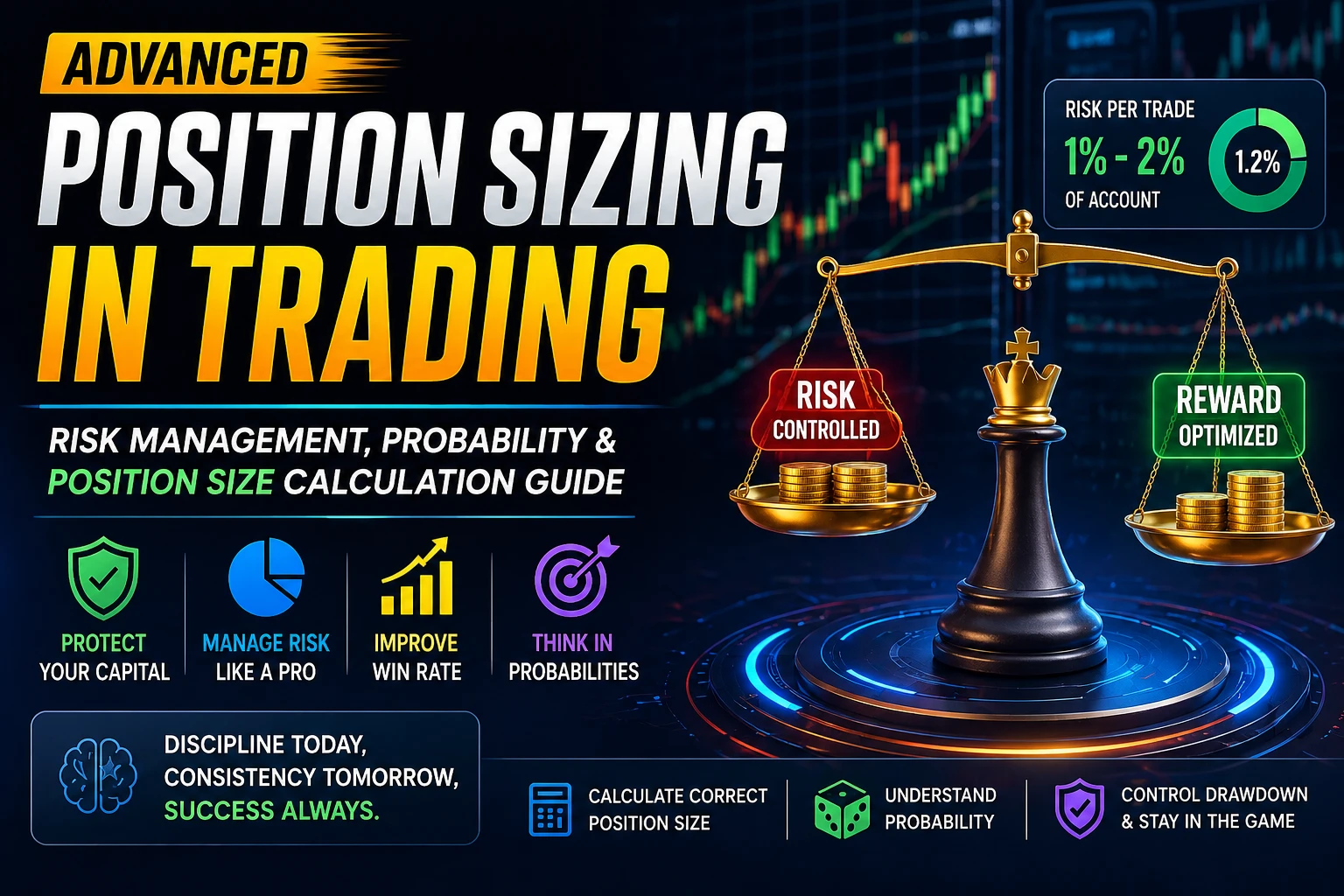
In this article, we will go deeper into the practical application of position sizing and explore how professional traders use probability thinking, risk control, and disciplined position management to maintain long-term consistency in the financial markets.
Common Myths About Position Sizing in Trading
Many misunderstandings about trading come from unrealistic expectations or misinformation shared in trading communities. Position sizing is often misunderstood, which leads many traders to take unnecessary risks.
Understanding these myths can help traders build a more realistic and disciplined approach.
Myth 1: Bigger Position Size Means Bigger Profit
Many traders believe that increasing position size will automatically increase profits. While it is true that a larger position can generate larger gains if a trade succeeds, it also increases the potential loss if the trade fails.
Professional traders rarely focus on maximizing profit per trade. Instead, they focus on protecting their capital and maintaining consistency.
A trader who risks too much capital on a single trade may achieve quick gains, but they also risk large losses during unfavorable market conditions.
Myth 2: A Good Strategy Guarantees Profit
Some traders believe that once they find a profitable strategy, risk management becomes less important. This assumption is dangerous.
Even the most effective trading strategies experience losing trades. Markets are influenced by many factors including volatility, liquidity, economic events, and market sentiment. Because of this uncertainty, no strategy can guarantee consistent wins.
Position sizing ensures that each trade carries controlled risk, allowing the strategy's probability to work over many trades.
Myth 3: Professional Traders Take Big Risks
Another common misconception is that professional traders take large risks because they are confident in their strategies.
In reality, many experienced traders follow conservative risk management rules and risk only a small percentage of their capital per trade, often between 1% and 2%.
This disciplined approach helps them survive losing streaks and maintain long-term consistency.
Understanding Probability in Trading
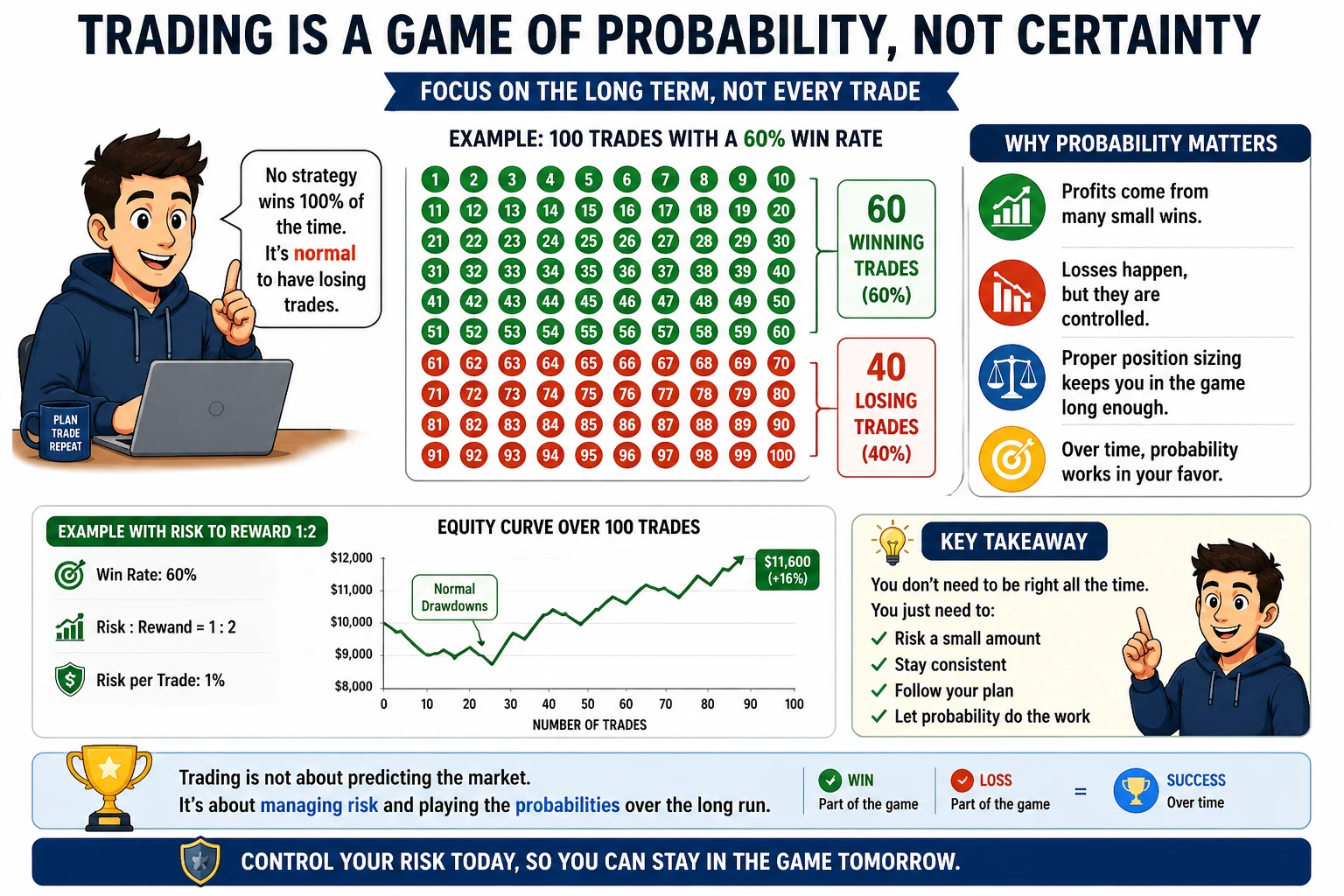
Trading is fundamentally a probability-based activity. No trader can predict the market with complete certainty.
Even a well-tested strategy may produce results such as:
Win rate: 60% Risk-reward ratio: 1:2
If a trader takes 100 trades using this strategy, the results might look like this:
- 60 trades may be profitable
- 40 trades may be losing trades
This means losses are a natural and unavoidable part of trading.
Position sizing plays a critical role here. If a trader risks too much capital on a single trade, a small number of losing trades can significantly damage the trading account.
For example, if a trader risks 20% of their capital per trade, just a few losing trades could wipe out a large portion of the account. However, if the trader risks only 1% per trade, even several losing trades in a row will not significantly affect the account balance.
This approach allows traders to stay in the market long enough for their strategy's long-term probability to work in their favor.
Why Many Beginner Traders Blow Their Accounts
Many beginners lose their trading capital not because their strategy is completely wrong but because they ignore risk management principles.
Several common behaviors contribute to this problem:
- Risking too much capital on a single trade
- Increasing position size after a loss to recover quickly
- Overtrading during volatile market conditions
- Ignoring stop-loss levels
- Allowing emotions such as fear or greed to influence decisions
These mistakes often occur when traders focus on short-term profits instead of long-term sustainability.
Position sizing helps traders build a structured trading plan that limits risk and prevents emotional decision-making.
How Professional Traders Apply Position Sizing
Professional traders approach position sizing as part of a structured risk management framework.
Rather than deciding position size randomly, they apply consistent rules.
The 1% Risk Rule
One common rule used by many traders is risking 1% of trading capital per trade.
For example:
Account balance: $10,000 Risk per trade: 1% Maximum loss per trade: $100
This rule ensures that even multiple losing trades will not severely damage the account.
The 2% Risk Rule
Some traders may choose to risk slightly more, such as 2% per trade, depending on their trading style and risk tolerance.
However, risking more than this can significantly increase drawdown risk.
Managing Drawdowns
Even profitable traders experience losing streaks. Position sizing helps control drawdowns by limiting the impact of each losing trade.
This allows traders to continue trading without significant emotional pressure.
How to Calculate Position Size in Trading
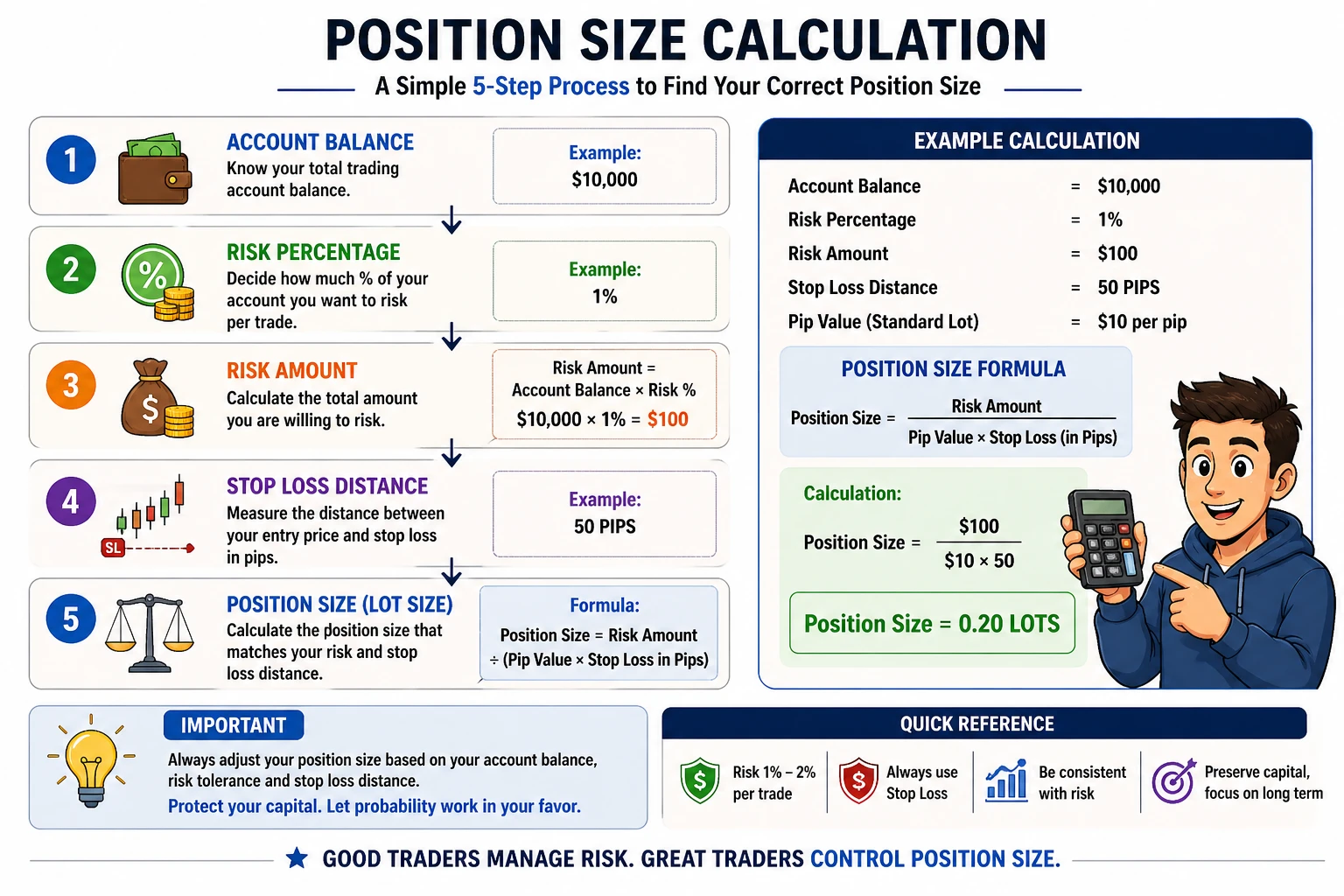
To apply position sizing effectively, traders must understand how to calculate position size using three important elements:
- Account balance
- Risk percentage per trade
- Stop-loss distance
Step-by-Step Example
Suppose a trader has the following conditions:
Account balance: $10,000
Risk per trade: 1%
This means the trader is willing to risk $100 per trade.
Next, the trader determines the stop-loss distance based on market analysis.
For example, if the stop-loss distance is 50 pips, the position size should be calculated in such a way that a 50-pip movement against the trade results in a $100 loss.
If the stop-loss distance is larger, the position size must be reduced to keep the risk within the $100 limit.
This ensures that risk remains consistent regardless of market volatility.
Understanding this relationship between stop-loss distance and position size is essential for proper risk management.
Common Position Sizing Methods Used by Traders
There are several practical approaches traders use to manage position size.
Fixed Percentage Risk Method
This is one of the most common methods.
Traders risk a fixed percentage of their capital on each trade, typically between 1% and 2%.
Advantages:
- Consistent risk management
- Protects capital
- Easy to calculate
Fixed Capital Allocation
Some traders allocate a fixed amount of capital to each trade.
For example, a trader might decide to use $1,000 per trade regardless of account size.
While this method is simple, it may not adjust well to different market conditions.
Stop-Loss Based Position Sizing
This method calculates position size based on the distance between entry price and stop-loss level.
The goal is to ensure that the potential loss stays within the trader's predefined risk percentage.
This approach is widely used by professional traders because it adapts to market structure and volatility.
Position Sizing Checklist Before Entering a Trade
Before executing a trade, traders should review a simple checklist.
Questions to consider:
- What percentage of my account am I risking?
- Where is my stop-loss level?
- Does this trade align with my trading strategy?
- Is the position size calculated correctly?
- Does the risk-reward ratio justify the trade?
Using such a checklist helps traders remain disciplined and avoid impulsive decisions.
Key Lessons from Position Sizing
Several important lessons emerge from understanding position sizing.
- Capital protection is more important than maximizing profit per trade
- Losses are a normal part of trading
- Consistent risk management allows strategies to work over time
- Emotional discipline improves when risk is controlled
- Long-term survival in the market depends on proper risk management
Conclusion
Position sizing is one of the most important elements of professional trading because it connects strategy, risk management, and trading psychology into a single framework.
While strategies help traders identify trading opportunities, position sizing ensures that risk remains controlled. This allows traders to manage losses, maintain discipline, and give their trading strategy enough time to perform according to its long-term probability.
For traders who aim to succeed in financial markets, learning how to apply position sizing consistently is an essential skill.
This article is provided for educational purposes only and does not constitute financial advice.
Frequently Asked Questions
Can position sizing eliminate trading losses?
No. Losses are unavoidable in trading. Position sizing helps ensure that losses remain manageable and do not destroy the trading account.
How much should beginners risk per trade?
Many traders recommend risking 1–2% of trading capital per trade.
Why do traders lose accounts quickly?
Many traders lose accounts because they risk too much capital on individual trades and ignore proper risk management.
Is position sizing more important than strategy?
Both are important, but without proper position sizing, even a good strategy may fail.

Written by
Trade Together Research
Trade Together Research is a professional market analysis team providing forex, gold, and crypto trading insights, technical analysis, and educational guides.. Learn more about our research team on the About page.