How Automated Trading Systems and Expert Advisors (EAs) Are Built
Tue Oct 27 2026
Introduction
Imagine you trade EURUSD manually. You check the market direction, wait for your entry signal, calculate your lot size, and place a trade. Every time you trade, you follow a set of rules.
Now imagine a computer following those same rules for you.
That is the basic idea behind automated trading. Instead of checking the chart and placing every trade yourself, you use software to evaluate predefined conditions and execute trading instructions when the required conditions are satisfied.
In the previous articles of the TradeTogether Forex Automated Trading Masterclass, we explored what automated trading is and how to convert a trading strategy into clear, objective rules.
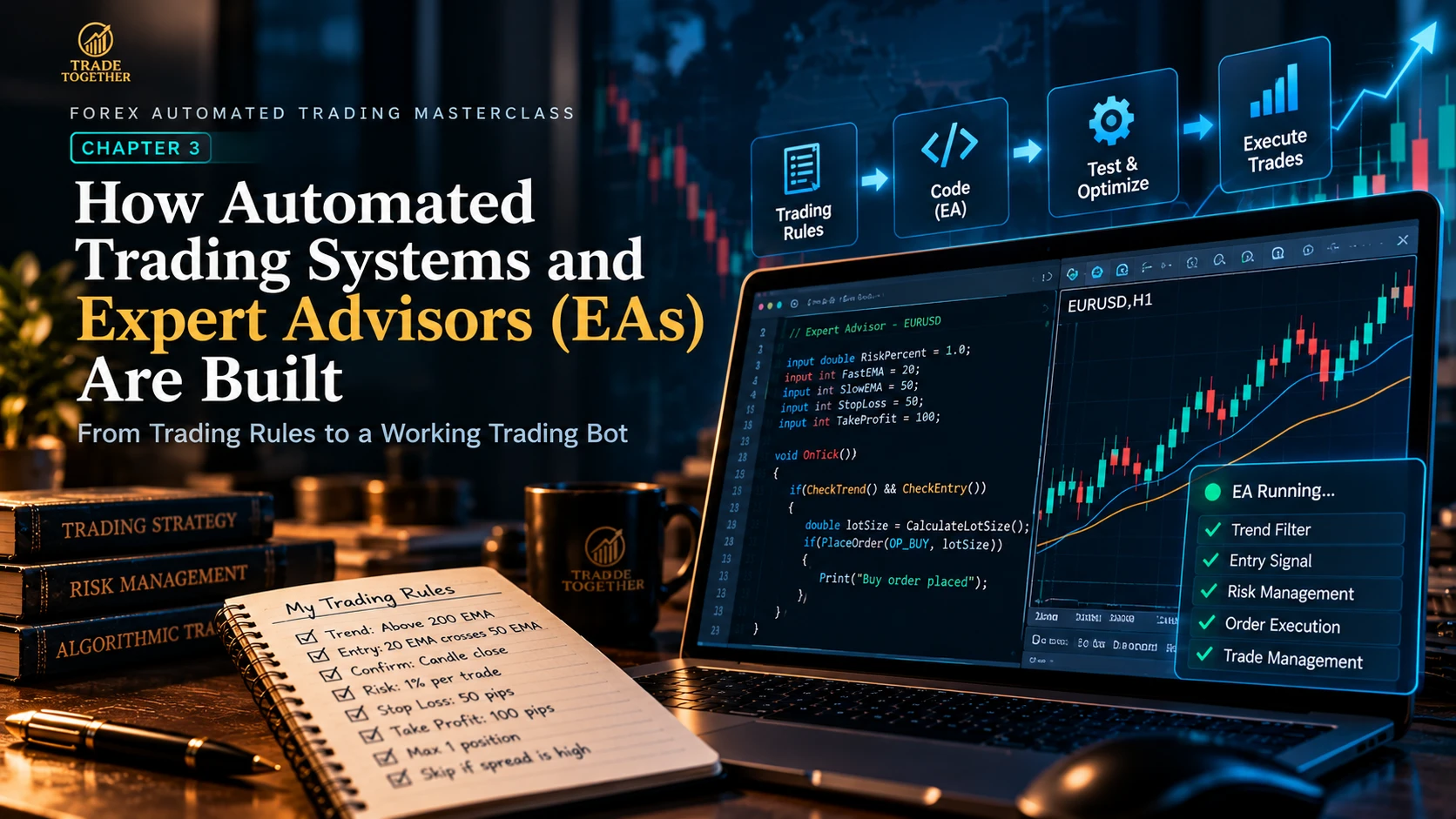
In this chapter, we will take the next step: understanding how those rules become a working trading bot. You do not need any programming knowledge to follow this article. We will explain the concepts through simple examples and practical Forex scenarios.
1. How Does a Trading Bot Work?
Think of a trading bot as a computer assistant that follows a checklist.
Suppose you ask someone to monitor EURUSD and follow these instructions:
-
Check whether the market meets your trend condition.
-
Wait for your entry signal.
-
Confirm that the required conditions are satisfied.
-
Calculate the appropriate trade size.
-
Place the trade only if all required checks pass.
A trading bot follows a similar process, except that software evaluates the instructions using available market information.
The basic process looks like this:
Market Prices → Check Trading Rules → Confirm Conditions → Calculate Risk → Place an Order
For example, suppose your strategy allows buying EURUSD only when the market is above a particular moving average and your entry signal appears.
If both conditions are satisfied, the bot can proceed to the next checks. If the conditions are not satisfied, it should wait rather than enter a trade.
This is why clearly defined rules are important. A computer cannot reliably follow vague instructions such as “buy when the market looks strong” unless that instruction is converted into measurable conditions.
Automation makes the execution of rules more systematic, but it does not guarantee profitable trades.
2. What Is an Expert Advisor (EA)?
An Expert Advisor, commonly called an EA, is a program that runs within the MetaTrader trading platform.
You can think of an EA as a digital assistant that monitors the market according to instructions provided by its developer.
Depending on how it is designed, an EA can:
- Identify trading signals.
- Check indicators and market conditions.
- Calculate trade volume.
- Place orders through the trading platform.
- Set or manage stop-loss and take-profit levels.
- Monitor open positions and follow exit rules.
For example, a trader may want an EA to buy EURUSD when a particular moving-average crossover occurs, provided the spread is acceptable and no other position is open.
The EA checks these conditions and attempts to place an order when the requirements are met.
What Are MT4 and MT5?
MetaTrader 4 (MT4) and MetaTrader 5 (MT5) are trading platforms that support automated trading.
| Feature | MetaTrader 4 (MT4) | MetaTrader 5 (MT5) |
|---|---|---|
| Automated Trading Program | Expert Advisor (EA) | Expert Advisor (EA) |
| Main Programming Language | MQL4 | MQL5 |
| Development Environment | MetaEditor | MetaEditor |
| Strategy Testing | Built-in Strategy Tester | Built-in Strategy Tester with additional testing capabilities |
MQL4 and MQL5 are programming languages used to develop trading programs for their respective platforms. You do not need to learn these languages to understand how an EA works.
The important point is that an EA follows its programmed instructions. It does not automatically understand market conditions the way an experienced human trader might.
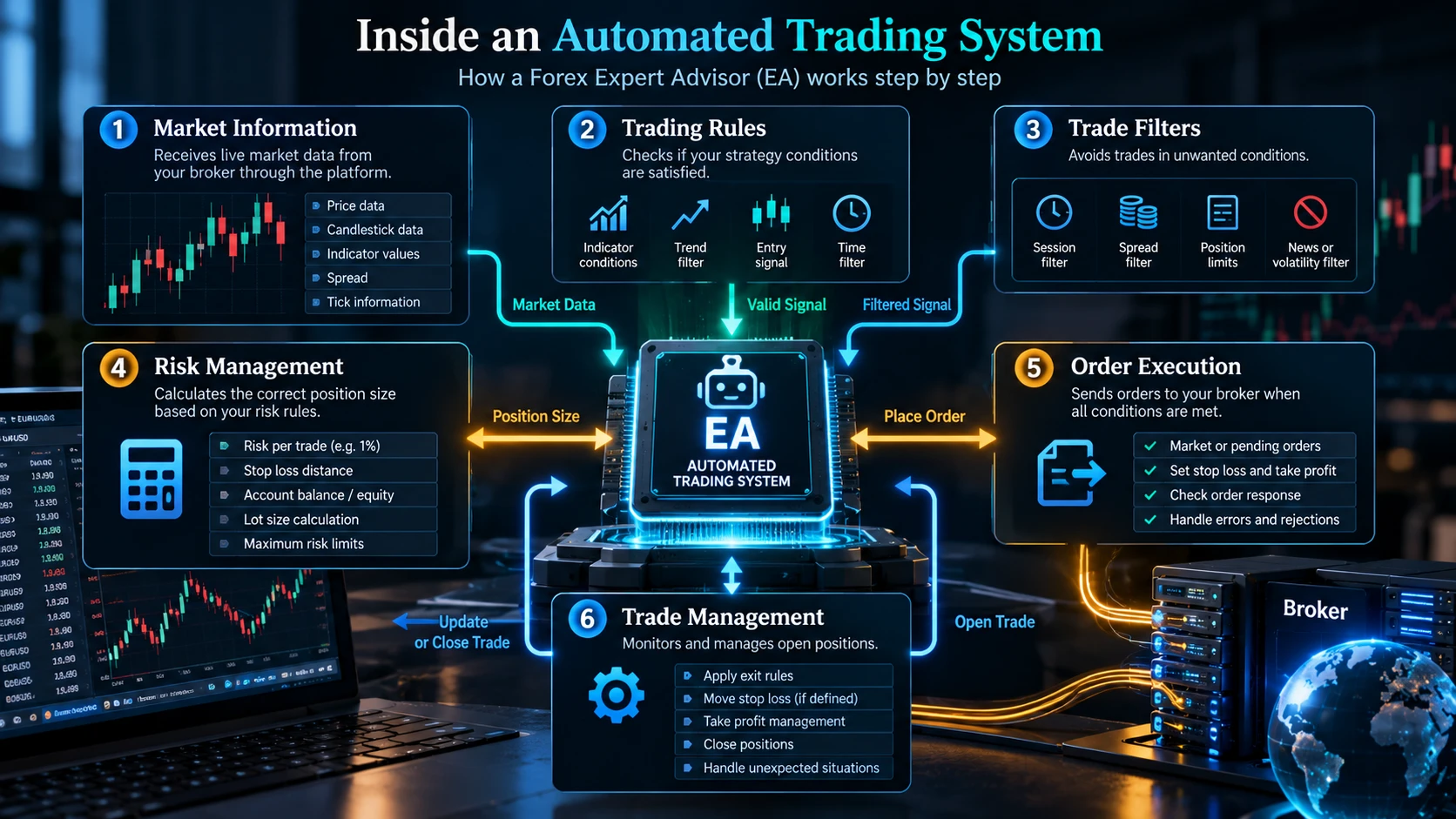
3. What Happens Inside an Automated Trading System?
A trading bot does more than identify a buy or sell signal. Several steps must work together before a trade can be placed and managed.
Consider these components as different jobs performed by the same system.
Market Information: What Is Happening in the Market?
First, the bot needs information about the instrument it is monitoring.
For EURUSD, this may include prices, candlestick data, indicator values, and the difference between buying and selling prices.
Without the required information, the bot cannot correctly evaluate its trading rules.
Trading Rules: Is There a Valid Signal?
Next, the bot checks whether the conditions defined by the strategy have been met.
For example, it may check the market trend and then look for a specific moving-average crossover.
A signal simply means that the programmed conditions have been satisfied. It does not mean the market must move in the expected direction.
Risk Management: Is the Trade Permitted?
Before placing an order, the bot can check the allowed risk, calculate the position size, and verify whether trading restrictions have been triggered.
For example, a rule might prevent new trades if a predefined daily loss limit has been reached.
Order Execution: Can the Trade Be Placed?
If all required checks pass, the bot sends an order request through the trading platform.
However, a trade is not guaranteed to execute at the expected price. The broker may reject an order, prices may change, or the available margin may be insufficient.
Trade Management: What Happens After Entry?
After a position opens, the bot can follow its exit rules, monitor the position, and manage the stop-loss or take-profit where supported.
A properly designed system also needs instructions for handling errors, rejected orders, and unexpected situations.
The key idea: An automated trading system is a sequence of connected tasks. A good entry signal alone is not enough; the system must also calculate risk, handle orders, and manage open trades.
4. How Do Trading Rules Become Computer Instructions?
In Article 2, we discussed why trading rules must be objective rather than based on vague judgments.
Now consider how a developer would use those rules to build a bot.
| Trading Instruction | What the Bot Needs to Know |
|---|---|
| Buy when the 20 EMA crosses above the 50 EMA | How to identify the crossover and which timeframe to use |
| Enter after the candle closes | Wait until the specified candle has closed |
| Risk 1% of account equity | Calculate trade volume using stop-loss distance and account equity |
| Do not trade if the spread is too high | Check the spread against the predefined maximum |
| Close the trade at the target | Identify the exit condition and handle the closing order |
Let's take one example.
A trader says, “Buy EURUSD when the 20 EMA crosses above the 50 EMA.”
That sounds clear, but the developer still needs to determine whether the bot should act immediately during a candle or wait for the candle to close. The difference matters because an indicator crossover can appear and disappear before a candle finishes.
If the strategy requires a candle-close confirmation, the bot must follow that exact instruction.
This is how a trading idea becomes a set of computer instructions. The developer translates each condition into logic that the software can evaluate consistently.
The trader does not need to write the code personally, but understanding the rules makes it easier to communicate requirements and check whether the finished bot behaves as intended.
5. A Practical Example: A Simple EURUSD Trading Bot
Suppose a trader wants to automate a basic trend-following strategy.
The following example illustrates how the rules might be organised. It is educational, not a recommendation or a proven profitable strategy.
| Component | Example Rule |
|---|---|
| Instrument | EURUSD |
| Timeframe | 1-hour chart |
| Trend Filter | Price above the 200 EMA |
| Entry Signal | 20 EMA crosses above the 50 EMA |
| Confirmation | Wait for the candle to close |
| Position Sizing | Calculate volume using the risk limit |
| Stop-Loss | Use a predefined technical level |
| Take-Profit | Target a 1:2 risk-to-reward ratio |
| Trade Restriction | Do not trade if the spread is too high |
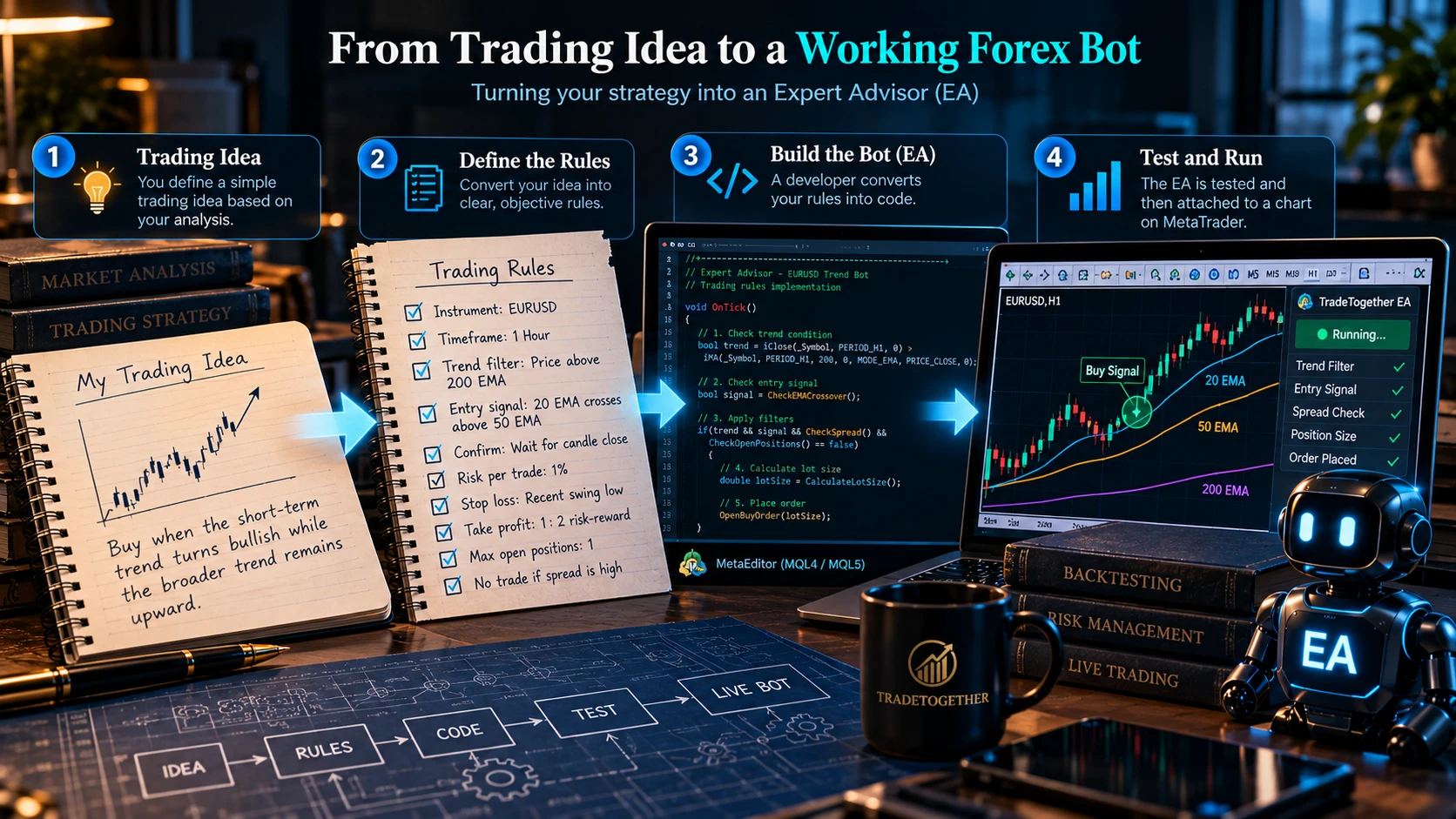
Imagine the bot detects a crossover.
First, it checks whether the broader trend condition is satisfied. Then it waits for the required candle confirmation and checks the spread. If a position is already open and the strategy allows only one position, the bot checks that restriction too.
Only if all the required conditions are satisfied will it attempt to place the trade.
If one of the conditions fails, it should not enter.
Even when the bot follows every instruction correctly, the trade can still lose. The purpose of automation is to implement a strategy consistently, not to eliminate uncertainty from the market.
6. Can You Build a Trading Bot Without Coding?
Yes, depending on the complexity of the strategy and the tools available.
There are three common approaches:
- Use a no-code or low-code tool. Some platforms allow traders to create automated rules through visual interfaces. These tools can be useful for relatively straightforward strategies, but their capabilities and limitations should be checked carefully.
- Learn programming. Traders who want more control over their systems can learn a relevant programming language, such as MQL4 or MQL5 for MetaTrader development.
- Work with a developer. You can document your strategy and ask a programmer to implement it. Clear rules, examples, and risk requirements help reduce misunderstandings.
Regardless of the approach, the trader should understand what the bot is designed to do, what conditions it checks, and how it handles risk and errors.
A tool that creates a bot quickly does not necessarily create a reliable or profitable system.
7. What Can Go Wrong When Building a Trading Bot?
Even a simple automated system can behave incorrectly if its instructions or implementation contain mistakes.
Common problems include:
- Unclear rules: The bot behaves differently from what the trader intended.
- Incorrect calculations: The position size or indicator values are calculated incorrectly.
- Duplicate orders: The system opens more trades than intended.
- Execution problems: An order is rejected or filled at a different price.
- Missing safeguards: The system does not handle unexpected errors or connectivity problems properly.
These problems demonstrate why building a bot involves more than making it generate buy and sell signals.
The software must implement the rules correctly, respect the trading constraints, and respond appropriately when something goes wrong.
It is also important to distinguish between a programming error and a strategy that simply performs poorly. Even perfectly implemented rules can produce losses if the underlying strategy does not have a durable advantage.
Key Learning: Building the Bot Is Only One Step
An automated trading system turns a documented trading strategy into a process that software can follow.
The main stages are straightforward to understand:
- Receive market information.
- Check the trading rules.
- Confirm that entry conditions are satisfied.
- Calculate the permitted risk and position size.
- Submit and manage orders.
- Handle errors and unexpected situations.
You do not need to be a programmer to understand these stages. However, every condition must be defined clearly if the system is expected to follow it consistently.
Market structure, trend, support and resistance, liquidity, and volatility may all influence a strategy. When these concepts are used in an automated system, they must be expressed as conditions the software can evaluate.
Risk management is equally important. A bot should not simply look for trades; it should also follow restrictions designed to control exposure.
Most importantly, a working trading bot is not the same as a profitable trading bot. Building the software is one stage. Understanding how the strategy behaves across different market conditions is another.
Frequently Asked Questions
1. What Is an Expert Advisor in Forex?
An Expert Advisor is a program that runs within MetaTrader and follows predefined instructions to evaluate trading conditions and perform supported trading operations.
2. Do I Need Coding Knowledge to Use Automated Trading?
No. You can use some existing EAs or no-code tools without writing code yourself. However, understanding the strategy, its risks, and its limitations is still important.
3. Can a Trading Bot Make Decisions by Itself?
A bot can evaluate market information and make decisions according to its programmed rules. Its decisions remain limited by its design, available data, and the conditions it was built to handle.
4. Can a Trading Bot Guarantee Profits?
No. A bot can execute instructions automatically, but it cannot guarantee that the strategy will succeed. Market uncertainty, trading costs, slippage, and technical problems can all affect results.
5. What Should I Do After Building a Trading Bot?
First, check that the software follows the intended rules and handles risk and orders correctly. The next step is to evaluate the strategy using appropriate testing methods, beginning with historical backtesting.
Conclusion
Building an automated trading system starts with a trading strategy and a clear set of rules. Those rules are translated into computer instructions that evaluate market information, identify signals, apply risk controls, and manage orders.
Expert Advisors are one way to implement this process on MetaTrader. Other development approaches are available, depending on the trader's needs and technical requirements.
The main lesson is that automation can make the execution of a strategy more systematic, but it cannot remove market risk or guarantee profitability.
Want to learn the complete process from the beginning? Explore the TradeTogether Forex Automated Trading Masterclass, a beginner-friendly series covering everything from automation basics and strategy rules to bot development, backtesting, risk management, and deployment.
The next chapter will focus on backtesting a Forex trading strategy—how to evaluate an automated system using historical market data, understand its results, and recognise the limitations of historical testing.

Written by
Trade Together Research
Trade Together Research is a professional market analysis team providing forex, gold, and crypto trading insights, technical analysis, and educational guides.. Learn more about our research team on the About page.