Why the Indian Stock Market Fell Today: Key Reasons Behind the Nifty and Sensex Gap-Down Opening (13/2/2026 Friday)
Fri Feb 13 2026
Market Context: Risk Sentiment Turned Defensive
Before the opening bell, global markets were already showing signs of hesitation, particularly in technology-heavy segments. At the same time, traders were preparing for important macroeconomic data from the US, leading to cautious positioning across risk assets.
When Indian markets opened, the negative global tone combined with domestic profit booking caused a clear gap-down start. Early weakness then attracted additional selling, keeping recovery attempts limited.
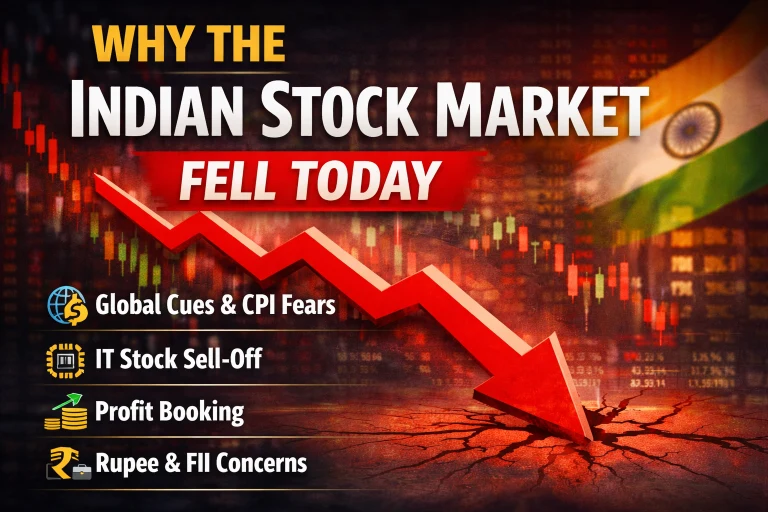
5 Key Reasons Why the Indian Stock Market Fell Today
1️⃣ Weak Global Cues and Risk-Off Sentiment
Overnight weakness in international markets created a defensive mood among traders. When global risk appetite declines, emerging markets like India often see cautious positioning at the open, resulting in gap-down moves.
2️⃣ Heavy Selling in IT Stocks
Technology stocks played a major role in dragging indices lower. Since IT companies carry significant weight in Nifty and Sensex, weakness in this sector quickly affects overall index performance. Global growth concerns and cautious sentiment around technology demand added pressure.
3️⃣ Caution Ahead of US Inflation (CPI) Data
Traders reduced exposure ahead of US inflation numbers, which influence future interest rate expectations. Higher inflation could delay rate cuts, strengthening the US dollar and reducing short-term risk appetite in emerging markets.
4️⃣ Profit Booking After Recent Gains
After recent upward movement in Indian indices, short-term traders likely chose to lock in profits. Profit booking is a normal market behavior and often intensifies when global uncertainty increases.
5️⃣ Currency and Institutional Flow Concerns
Rupee volatility and uncertainty around foreign institutional flows added another layer of caution. When currency movement becomes unpredictable, large players often reduce aggressive positioning until stability returns.
Bias and Market Structure
Setup Logic (Educational Perspective)
Invalidation / Risk Note
Understanding Sector Leadership in Market Moves
Large market-leading companies often influence index direction more than smaller stocks. Understanding how dominant businesses affect overall sentiment can help traders interpret market behaviour more clearly.
You can explore this concept further in our related article on monopoly stocks in India: https://www.tradetogether.in/articles/monopoly-stocks-in-india
What Traders Should Watch Next
Frequently Asked Questions (FAQ)
Why did the Indian stock market open gap down today?
A combination of weak global cues, IT sector selling, and caution ahead of US inflation data contributed to the gap-down opening.
How does US CPI data affect Indian markets?
US inflation influences global interest rate expectations. Higher inflation may delay rate cuts, which can reduce risk appetite and impact emerging markets like India.
Why do IT stocks affect Nifty and Sensex so much?
IT companies have high index weightage. Large moves in this sector directly influence benchmark indices.
Is a gap-down opening always bearish?
Not necessarily. While it shows early weakness, markets can recover if buyers appear near important support levels.
How should traders approach volatile market sessions?
Most professional traders reduce position size, wait for confirmation, and prioritize risk management instead of chasing moves.
Can global markets affect Indian market opening?
Yes. Overnight moves in US and Asian markets frequently influence sentiment and can lead to gap-up or gap-down openings in India. Final Takeaway
Final Takeaway
Today’s market decline was driven by a combination of global caution, sector-specific weakness, macro uncertainty, and short-term profit booking. While the tone remained defensive, such sessions are part of normal market cycles rather than immediate trend reversals.
For traders, focusing on market structure, risk control, and confirmation signals remains more important than reacting emotionally to headlines.

Written by
Trade Together Research
Trade Together Research is a professional market analysis team providing forex, gold, and crypto trading insights, technical analysis, and educational guides.. Learn more about our research team on the About page.