What Overtrading Really Means in Forex (And Why “One Trade Per Day” Can Hurt Your Edge)
Sat Feb 21 2026
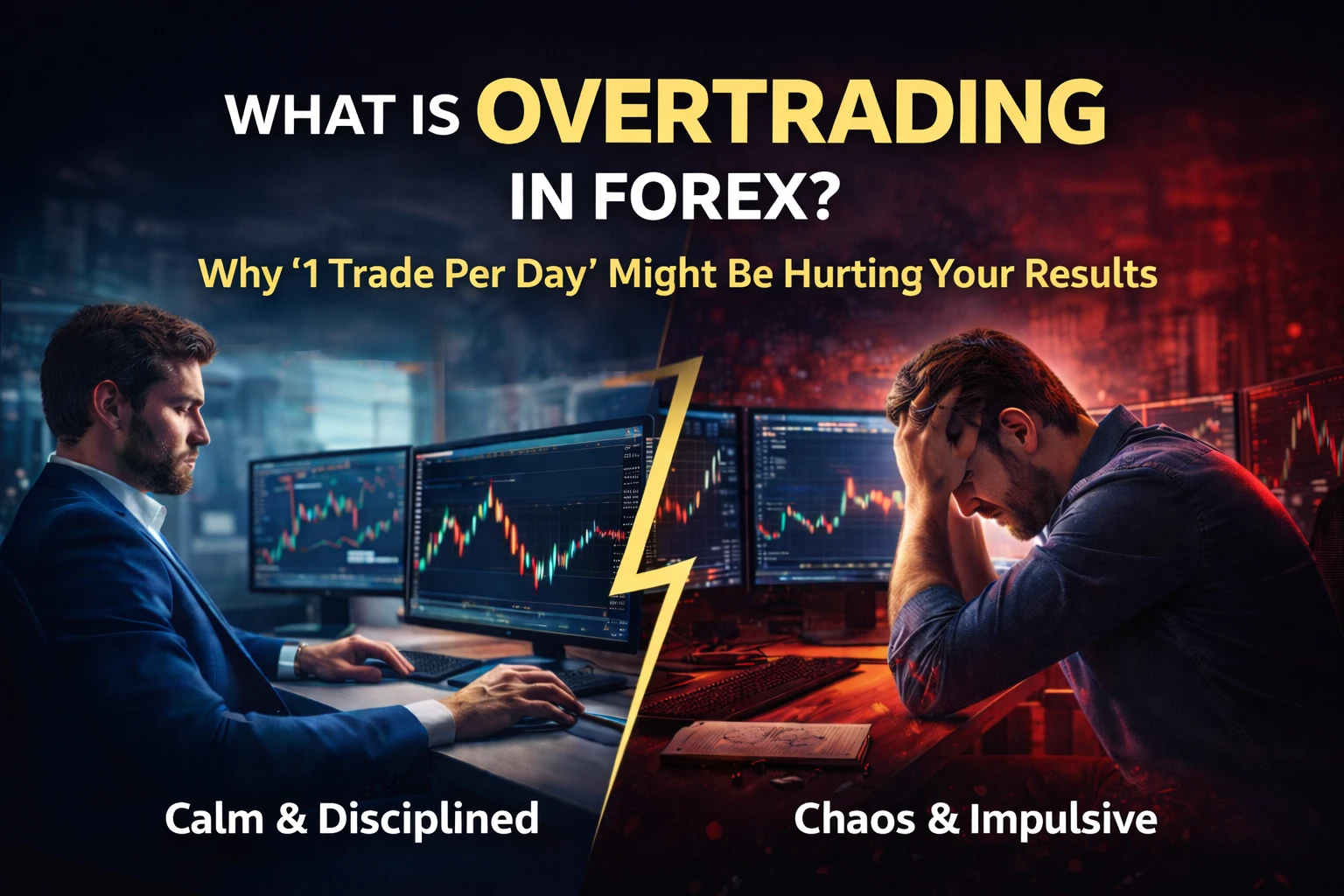
Forex trading is often described as a game of probability. Yet many traders unknowingly damage their long-term edge—not because their strategy fails, but because their execution does.
One of the most misunderstood concepts in retail trading is overtrading. It is frequently defined as “taking too many trades per day.” However, from a professional risk management perspective, overtrading is not about frequency.
It is about discipline, structure, and respect for statistical edge.
This article explains what overtrading really means, why it happens, how it affects expectancy, and what traders should learn from it.
What Is Overtrading in Forex?
" Overtrading is the act of taking trades that are not aligned with a tested trading plan or predefined risk parameters."
It is not defined by the number of trades taken in a day.
A trader who takes five trades that all meet their strategy rules is not overtrading.
A trader who takes one emotional trade outside their plan is overtrading.
Key Distinction
In professional environments, traders are evaluated based on adherence to process—not the number of trades executed.
Why Traders Overtrade
Overtrading usually emerges from psychological pressure rather than market conditions.
1. Emotional Reaction to Loss
After a losing trade, traders often attempt to recover quickly. This “revenge trading” disrupts risk management and position sizing.
2. Fear of Missing Out (FOMO)
High volatility during London or New York trading sessions can create urgency. Traders enter without confirmation, chasing liquidity moves.
3. Misunderstanding Probability
Many traders believe each trade should win. In reality, even a strong strategy may have a 50% win rate. Losses are part of the statistical distribution.
4. Lack of Structured Trading Plan
Without clear rules on market structure, entry confirmation, stop-loss placement, and risk percentage, decision-making becomes reactive.
Overtrading is therefore a process failure, not a market failure.
The Probability Problem: When “One Trade Per Day” Becomes a Mistake
A common rule promoted to beginners is: “Take only one trade per day.”
This may sound disciplined, but it can unintentionally damage expectancy.
Example:
Assume a strategy has:
- 50% win rate
- • 1:1 risk-reward ratio
- • Four valid setups per day
Over four trades, statistics may look like:
- Trade 1 — Loss
- • Trade 2 — Win
- • Trade 3 — Win
- • Trade 4 — Loss
Now consider a trader who takes only the first trade each day.
- The trader executes the first setup.
- The trader stops trading for the day because they follow a “one trade per day” rule.
They stop because they follow a “one trade rule.”
However, the next two valid setups (which they skipped) might have been the winners.
The issue here is not overtrading.
It is under-executing a statistical edge.
Professional Perspective
If a setup meets all criteria:
- Execute every setup that meets your trading rules
- Maintain consistent risk parameters across trades
- Allow probability to play out over a large sample size
It should be executed consistently.
Probability works over a series of trades—not isolated outcomes.
The Real Risk: Breaking Your System
Overtrading occurs when:
- Trades are taken outside predefined setup criteria
- Position size increases emotionally after losses
- Stop-loss rules are ignored
- Entries are based on impulse rather than strategy
Even a single violation can distort long-term performance.
Risk Management Layer
Professional traders control exposure by:
- Risking a fixed percentage of capital per trade
- Limiting total daily risk exposure
- Maintaining consistent position sizing
- Avoiding highly correlated trades that increase exposure
This ensures that even if multiple valid setups occur, overall capital preservation remains intact.
The focus is not on limiting trade count.
The focus is on limiting risk.
Overtrading vs Undertrading: Two Sides of the Same Problem
Many discussions ignore the opposite issue: undertrading.
Skipping valid setups due to fear can be equally harmful.
Both behaviors stem from emotional interference.
| Behavior | Meaning | Impact | ||
|---|---|---|---|---|
| ---------- | --------- | -------- | ||
| Overtrading | Taking trades outside the trading plan due to emotional or impulsive decisions | Increases risk exposure and can damage capital quickly | ||
| Undertrading | Skipping valid setups because of fear or hesitation | Reduces the statistical edge of the trading strategy | ||
| Professional Execution | Taking every valid setup while maintaining strict risk management | Allows probability and strategy expectancy to work over time |
Consistency is the foundation of edge realization.
What Traders Should Learn
- Trading outcomes are probabilistic, not certain
- Consistency in execution matters more than individual trade results
- Risk management protects capital during losing periods
- Emotional discipline is essential for long-term survival
- Structured decision-making improves long-term performance
Forex trading involves volatility, shifting liquidity, and macroeconomic drivers such as central bank policy. No single trade determines long-term performance.
Execution consistency does.
Frequently Asked Questions
1. Is taking multiple trades in one day overtrading?
No. If all trades meet your predefined rules and risk limits, it is disciplined execution.
2. Can overtrading blow an account?
Yes. Emotional trading combined with poor position sizing can accelerate drawdowns significantly.
3. Should beginners limit trades per day?
Beginners should limit risk exposure, not arbitrarily limit valid setups.
4. How does risk-reward affect overtrading?
A strong risk-reward ratio reduces the need for frequent trading. However, violating stop-loss discipline increases damage regardless of ratio.
5. Is overtrading more psychological or technical?
Primarily psychological. It reflects lack of discipline and impulse control rather than technical analysis failure.
Conclusion
Overtrading is not defined by how many trades you take.
It is defined by whether you respect your trading plan.
A strategy with positive expectancy requires consistent execution. Skipping valid trades or taking emotional ones both disrupt probability distribution.
Professional trading is built on:
- Discipline
- Capital preservation
- Structured execution
Markets will always contain uncertainty. Capital preservation and structured execution are the only sustainable advantages.
This content is for educational purposes only and does not constitute financial advice. Trading leveraged instruments involves significant risk.

Written by
Trade Together Research
Trade Together Research is a professional market analysis team providing forex, gold, and crypto trading insights, technical analysis, and educational guides.. Learn more about our research team on the About page.