USDCAD 1-Hour Market Structure Analysis – Liquidity Sweep and Momentum Shift | Wednesday, April 30, 2026
Thu Apr 30 2026
More analysis for this pair:
View all USDCAD market analysis →Forex forecast for this pair:
View USDCAD forecast →Market Context
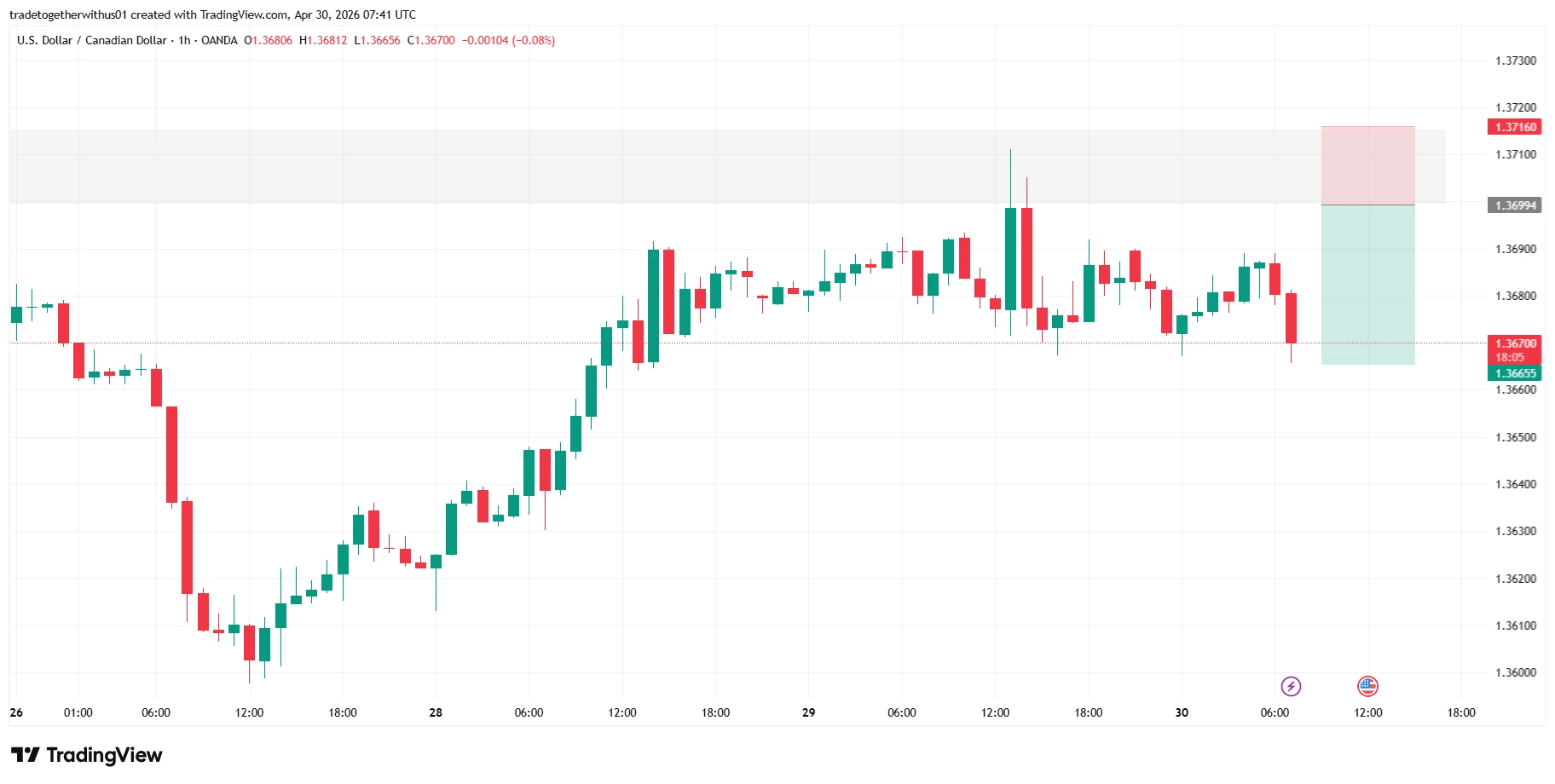
The USD/CAD pair continues to display technically driven price behavior as market participants respond to liquidity zones and institutional order flow. On the 1-hour timeframe, price recently interacted with a previously identified structural region that combined a high-volume order block and imbalance area, creating a technically significant reaction zone.
These areas often act as magnets for liquidity before the market reveals its next directional intention. The recent price action around this zone provides a useful case study for understanding how liquidity sweeps and momentum shifts unfold in real market conditions.
Higher Timeframe Structural Context
On the higher intraday structure, USD/CAD had been trading within a defined premium range, gradually revisiting areas where institutional participation was previously concentrated.
The upper reference region between 1.37066 and 1.37163 represented a technically meaningful zone due to several overlapping factors:
- Presence of a prior order block
- A visible fair value gap / imbalance region
- Elevated trading activity confirmed through fixed range volume analysis
- Alignment with roughly 0.5 ATR of the 1-hour volatility range
When multiple structural elements converge within a narrow price band, markets often revisit these zones to rebalance liquidity.
Current Chart Structure and Key Observations
As price returned to the identified range, the market briefly swept liquidity above the structural boundary before momentum shifted.
Several important observations emerged during this sequence:
Liquidity Sweep Above the Reference Zone
Price extended slightly beyond the upper boundary, absorbing resting liquidity that had accumulated around previous highs.
Momentum Shift Following the Sweep
After the liquidity event, the market showed aggressive rejection, indicating that the move above the zone may have been a liquidity collection rather than a sustained breakout.
Lower Timeframe Structural Change
When the chart is observed on the 5-minute timeframe, a clear change of character (CHOCH) becomes visible, suggesting that short-term momentum temporarily rotated toward the downside.
Such shifts are often used by institutional participants to reposition after liquidity events.
Educational Explanation of the Marked Structural Zones
The chart highlights three key areas that serve as an educational example of market structure dynamics.
Upper Structural Reference Zone
The region between 1.37066 and 1.37163 functioned as a liquidity magnet where prior institutional activity had occurred.
Markets frequently revisit such zones for two main reasons:
- To rebalance previously inefficient price delivery
- To collect liquidity resting above visible highs
The sweep beyond this range illustrates how markets often move slightly beyond obvious levels before revealing the true directional response.
Reaction Zone Following Momentum Shift
After the liquidity event, price formed a lower-timeframe structural transition. This type of transition typically occurs when:
- Aggressive participants step into the market
- Short-term order flow shifts direction
- The market begins delivering price toward the next liquidity pocket
The reaction area on the chart represents the point where momentum began transitioning.
Downside Liquidity Objective
The lower highlighted region on the chart corresponds to previous liquidity and structural inefficiencies that had not yet been fully revisited.
Markets frequently rotate toward such areas once momentum begins to shift.
What Market Participants Should Watch Next
Going forward, several technical factors may provide clues about the next phase of price development:
- Whether price remains below the upper reference zone
- How momentum behaves around intraday liquidity pockets
- The presence of further structure shifts on lower timeframes
- Whether the market continues delivering price toward unfilled inefficiencies
Observing these elements helps traders understand how institutional order flow may be evolving.
Learning Takeaway
This setup provides an excellent example of how markets often operate around liquidity and structural inefficiencies rather than simple support and resistance levels.
Key lessons include:
- Liquidity above visible highs is frequently targeted before reversals.
- Momentum shifts often appear first on lower timeframes.
- Combining volume analysis, ATR context, and structural zones can provide a deeper understanding of price behavior.
Traders who wish to develop a deeper understanding of these concepts can explore the full learning path in the Forex Trading Foundation Masterclass, which covers market structure concepts from beginner to advanced levels:Forex Foundations Masterclass.
Understanding the psychological aspect of market participation is equally important. The Trader Psychology Series discusses discipline, emotional control, and decision-making in volatile markets:Trader Psychology & Discipline Series.
Explore more analysis from this trading session:
View all newyork Session Analysis →Explore more forex forecasts and market outlooks:
View Forex Forecast Hub →Forex forecast for this session:
View USDCAD newyork Session Forecast →
Written by
Trade Together Research
Trade Together Research is a professional market analysis team providing forex, gold, and crypto trading insights, technical analysis, and educational guides.. Learn more about our research team on the About page.