Automated Trading Explained: Trading Bots, Manual vs Automated Trading, Benefits and Risks
Sun Sep 20 2026
Introduction
For many traders, trading means sitting in front of a chart, analyzing price, waiting for a setup, entering a position and managing the trade manually.
But what if some or all of those tasks could be handled by software?
This is where automated trading comes in.
Automated trading allows a trader to convert a clearly defined trading process into a set of rules that software can follow. The system can monitor markets, identify predefined conditions, calculate position size, place orders and manage trades without requiring the trader to perform every action manually.
However, automated trading is often misunderstood.
A trading bot is not a machine that knows where the market will move next. Automation does not guarantee profits, and simply converting a strategy into code does not make the strategy profitable.
The real purpose of automation is to make a defined trading process more systematic, repeatable and testable.
In this first chapter of the TradeTogether Automation Trading Series, we will look at what automated trading means, how trading bots work, how manual and automated trading differ, their advantages and disadvantages, and what a trader should understand before attempting to automate a strategy.
What Is Automated Trading?
Automated trading is the use of software to execute trading decisions or tasks according to predefined rules.
The important word here is predefined.
A human trader can look at a chart and say:
“The market looks bullish.”
A computer cannot work with such a subjective statement unless the trader defines exactly what “bullish” means.
For example, a strategy could define a bullish condition as:
- Price is above the 200 EMA.
- The 20 EMA is above the 50 EMA.
- Price breaks a previous high.
- The spread is below a specified level.
- The risk per trade is limited to 1%.
Now these conditions can be converted into instructions that software can understand.
A simplified automated trading process can look like this:
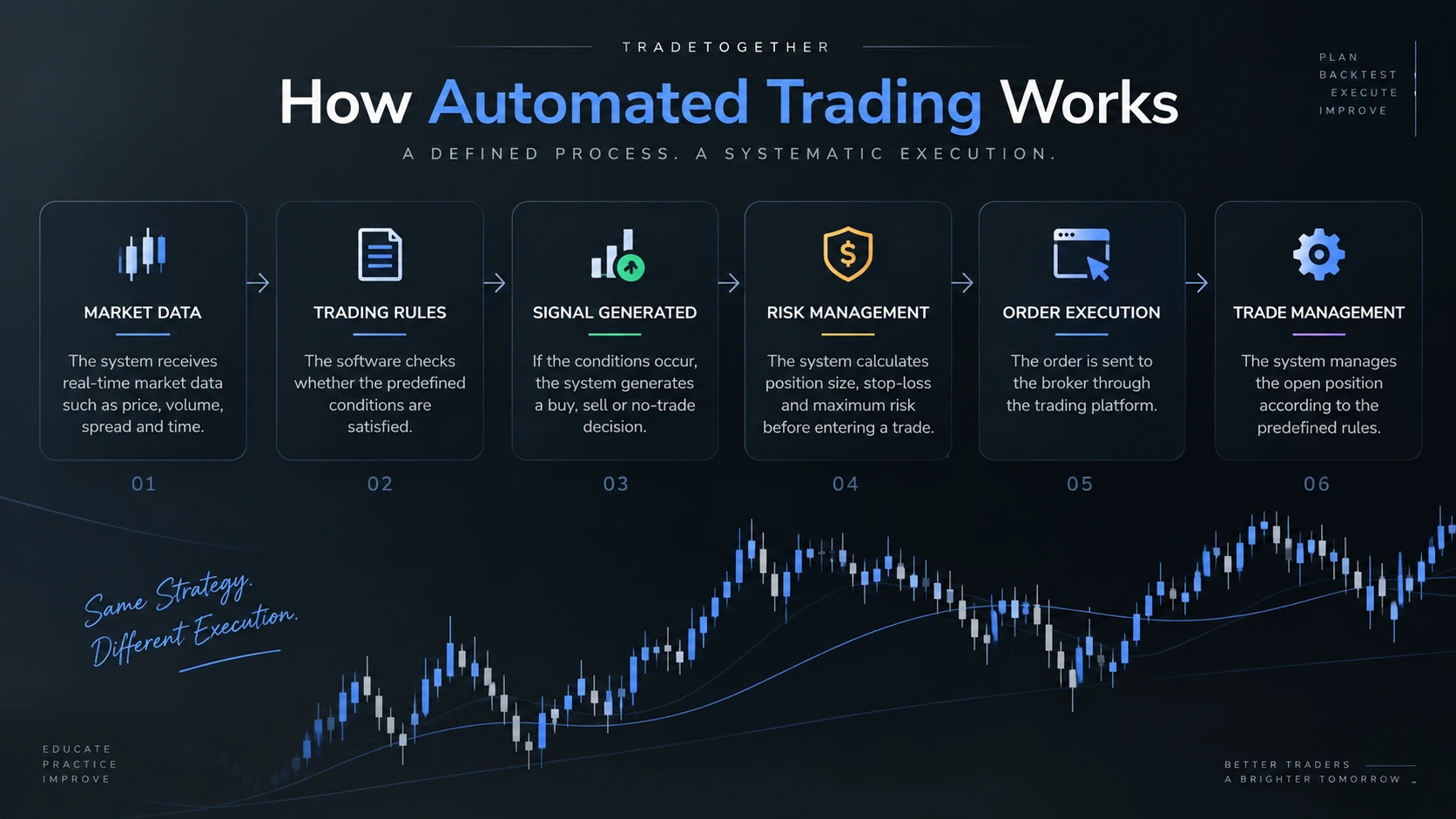
Market Data → Trading Rules → Signal → Risk Management → Order Execution → Trade Management
If the required conditions are not present, the system can simply wait.
This is important because automated trading does not mean trading continuously. A properly designed system may spend most of its time doing nothing and only act when the conditions defined by the strategy occur.
A Simple Example
Imagine a trader has a breakout strategy.
The rules are:
- Identify the previous day's high.
- Wait for price to break that level.
- Enter only when the predefined confirmation occurs.
- Place the stop-loss according to the strategy.
- Risk a fixed percentage of the account.
- Exit according to the predefined trade-management rules.
A manual trader performs these tasks themselves.
An automated system can monitor the market and perform the same process according to the programmed rules.
The strategy itself has not necessarily changed.
Only the method of execution has changed.
What Is a Trading Bot?
A trading bot is software designed to perform trading-related tasks according to programmed instructions.
Depending on its design, a trading bot can:
- Monitor one or multiple markets
- Analyze price data
- Calculate indicators
- Identify predefined conditions
- Generate trading signals
- Calculate position size
- Place orders
- Set stop-loss and take-profit levels
- Manage open positions
- Close trades according to predefined conditions
- Apply certain risk limits
A simple system may only generate alerts, while a more advanced system can handle almost the entire trading process.
But there is an important distinction:
A trading bot executes rules. It does not automatically create a trading edge.
If the underlying strategy is poorly designed, automation can simply make the same poor decisions consistently.
How Does Automated Trading Work?
Although automated trading systems can become technically complex, the basic process is relatively straightforward.
Market Data
The system receives information such as price, candles, spread, volatility, volume and time.
Trading Rules
The software checks whether the conditions defined by the strategy are satisfied.
Signal
If the required conditions occur, the system can generate a buy, sell or no-trade decision.
Risk Management
Before entering a trade, the system can calculate position size, stop-loss distance and maximum allowable risk.
Execution
The trading platform sends the order to the broker.
Real-world execution can still be affected by spread, slippage, latency and liquidity.
Trade Management
After entering a position, the system can manage it according to predefined rules, such as moving a stop-loss, taking partial profit or closing the position.
This means automation can cover much more than simply finding an entry.
Manual Trading vs Automated Trading
Manual and automated trading approach the same market in very different ways.
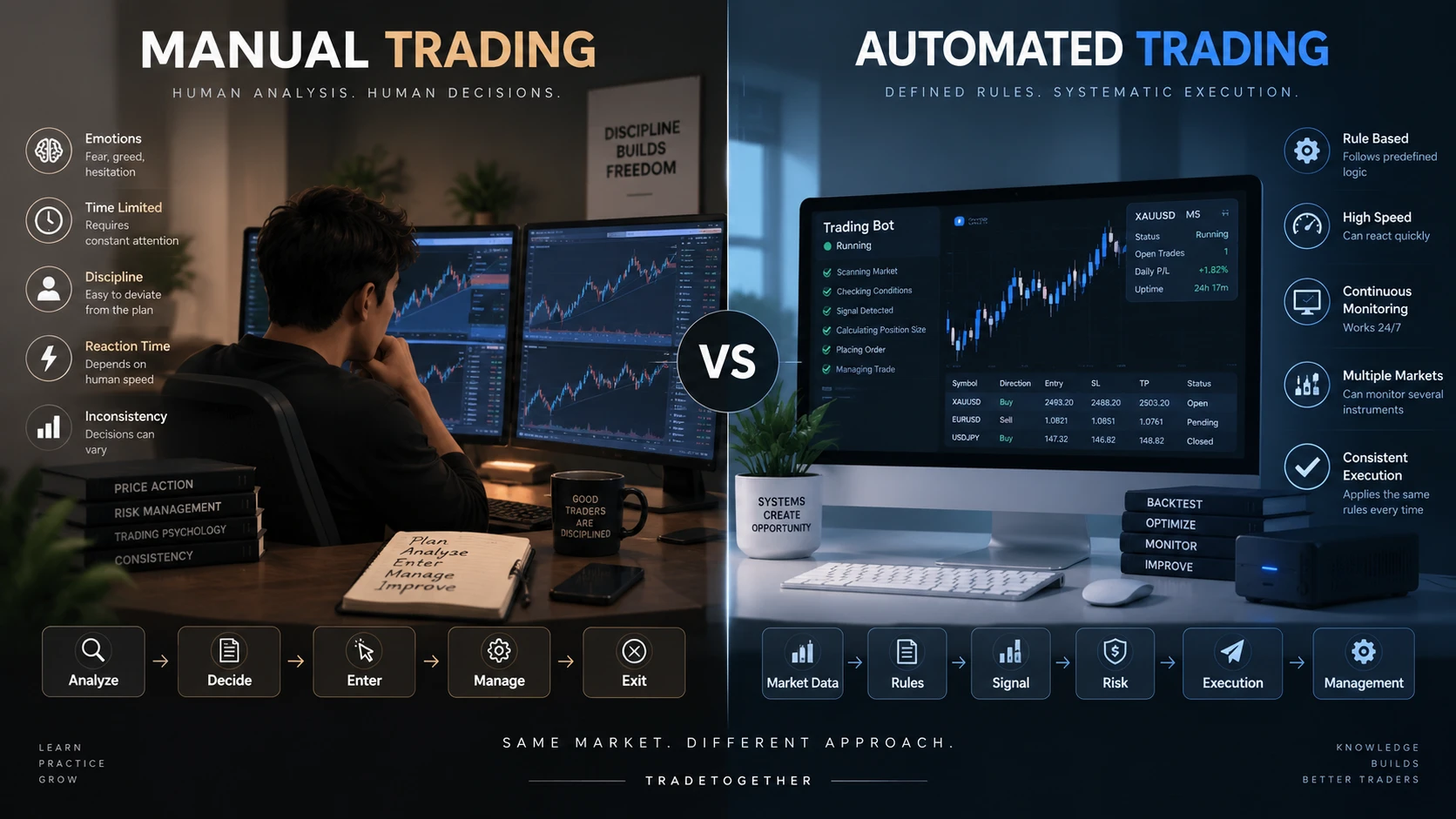
| Factor | Manual Trading | Automated Trading |
|---|---|---|
| Decision-making | Human analysis and judgment | Predefined rules and programmed logic |
| Execution | Trader places orders manually | Software can place orders automatically |
| Speed | Depends on human reaction | Can react very quickly |
| Emotional influence | Emotions can affect decisions | Emotional interference during execution is reduced |
| Consistency | Execution can vary from trade to trade | Rules can be applied consistently |
| Flexibility | Highly flexible | Limited by programmed rules |
| Market monitoring | Limited by human attention and time | Can monitor markets continuously |
| Multiple markets | Difficult to monitor many markets simultaneously | Can monitor multiple markets simultaneously |
| Backtesting | More difficult when decisions are discretionary | Easier when rules are clearly defined |
| Adaptability | Human can respond to unusual situations | Changes generally need to be programmed |
| Technical dependency | Relatively low | Higher |
| Main challenge | Discipline, emotions and consistency | Programming, testing and system reliability |
Neither approach is automatically better.
Manual trading gives the trader flexibility and contextual judgment. Automated trading focuses more on consistency and systematic execution.
The appropriate approach depends largely on the strategy and how clearly its decisions can be defined.
Advantages and Disadvantages of Manual and Automated Trading
| Trading Approach | Advantages | Disadvantages |
|---|---|---|
| Manual Trading | Flexible, allows contextual judgment, easy to adapt, no programming required | Emotional decisions, inconsistent execution, fatigue, limited attention and monitoring |
| Automated Trading | Consistent execution, fast, continuous monitoring, systematic testing, reduced emotional interference during execution | Programming errors, overfitting, technical failures, execution issues, limited flexibility |
The table highlights an important point: every advantage comes with a corresponding limitation.
For example, automation can execute rules consistently, but that consistency is only useful if the rules themselves are properly designed.
Similarly, manual trading allows a trader to react to unusual circumstances, but that flexibility can also lead to inconsistent decisions.
Why Do Traders Automate Their Strategies?
The best reason to automate is not:
“I want a bot that makes money while I sleep.”
A more realistic reason is:
“I have a clearly defined trading process, and I want that process to be executed and tested systematically.”
Automation can be useful when a trader wants to:
- Reduce repetitive manual tasks
- Improve execution consistency
- Monitor markets continuously
- Execute predefined rules quickly
- Apply systematic risk management
- Test a strategy using historical data
- Monitor multiple markets
- Reduce emotional interference during execution
Consider a trader who has spent months developing a strategy.
They know exactly when to enter, where to place the stop-loss, how much to risk and when to exit.
If those rules can be expressed precisely, automation becomes a logical next step.
The computer is not creating the strategy.
It is executing the strategy.
Risks of Automated Trading
Automation can make a trading process more systematic, but it also introduces its own risks.
Programming Errors
A trading idea can be correct while the code implementing it is wrong.
For example, a trader may intend to risk 1% per trade, but an error in position-size calculation could result in a different level of risk.
The computer may then execute that mistake consistently.
Overfitting
A strategy can be optimized so heavily for historical data that it performs extremely well in a backtest but struggles when exposed to new market conditions.
This is known as overfitting or curve fitting.
It is one of the major challenges in automated strategy development.
Technical Failures
Automated systems depend on technology.
Internet problems, VPS failures, platform issues, broker connectivity, software bugs or incorrect settings can interfere with execution.
Live Execution Differences
Historical testing cannot perfectly reproduce every condition found in live markets.
Spread, slippage, commissions, latency and liquidity can affect actual results.
Changing Market Conditions
Markets constantly change.
A strategy that performs well in a strong trending environment may behave differently when the market becomes range-bound.
An automated system will continue following its programmed rules unless it has been specifically designed to respond to changing conditions.
Can Trading Bots Guarantee Profits?
No.
A trading bot is a tool for executing a strategy. It is not a guarantee of profitability.
A profitable-looking backtest does not automatically mean that the same strategy will produce the same results in live trading.
The underlying strategy, risk management, execution conditions and market environment all matter.
The underlying strategy, risk management, execution conditions and market environment all matter.
This is why serious automated trading research should look beyond a simple profit figure.
Important areas include:
- Drawdown
- Number of trades
- Risk per trade
- Trade distribution
- Different market conditions
- Robustness
- Execution costs
- Parameter sensitivity
The objective should not simply be to find a system that looks impressive historically.
The objective is to understand why the system behaves the way it does and how reliably it can operate under different conditions.
What Should You Understand Before Automating a Strategy?
Before building or purchasing an automated trading system, the strategy itself should be clearly understood.
A sensible progression is:
Strategy → Rules → Programming → Backtesting → Robustness Testing → Risk Management → Forward Testing → Live Deployment
Each stage has its own challenges.
A strategy first needs a clearly defined logic. Those rules can then be programmed and tested using historical data.
After that, the trader can investigate whether the results remain reasonably stable under different conditions instead of relying on one optimized backtest.
Risk management should also be built into the system rather than treated as an afterthought.
Finally, forward testing can help evaluate how the system behaves outside the historical data used during development.
These subjects are important enough to deserve their own detailed chapters in the TradeTogether Automation Trading Series.
Key Learning
The biggest lesson from automated trading is simple:
Automation is not a replacement for trading knowledge.
It is a method of turning a defined trading process into something that can be executed, measured and tested systematically.
The relationship can be viewed like this:
Trading Idea → Strategy → Rules → Automation → Testing → Risk Management → Execution
If the strategy is unclear, automation will not solve the problem.
If risk management is poor, automation can execute poor risk management consistently.
If a backtest is overfitted, automation cannot make those historical results reliable.
But when a strategy is clearly defined and properly tested, automation can provide something extremely valuable:
consistency.
And consistency makes it easier to determine whether the strategy itself is working or whether problems are coming from manual execution.
Frequently Asked Questions
What is automated trading?
Automated trading uses software to execute predefined trading rules and tasks with limited or no manual intervention.
What is a trading bot?
A trading bot is software that monitors market conditions and performs trading-related tasks according to programmed instructions.
Is automated trading better than manual trading?
There is no universal answer. The appropriate approach depends on the strategy, the amount of discretion involved and the trader's objectives.
Can any Forex strategy be automated?
No. Strategies based on precise and measurable rules are generally easier to automate than strategies that depend heavily on subjective judgment.
Can trading bots guarantee profits?
No. A trading bot follows programmed rules but cannot guarantee that the underlying strategy will remain profitable.
Conclusion
Automated trading is not a shortcut to profits. It is a way to turn a clearly defined trading process into a more systematic and repeatable process.
Before moving into automation, traders should have a strong understanding of Forex, market analysis, risk management and trading psychology. You can continue building those foundations through the [Forex Foundations Masterclass] and [Trader Psychology & Discipline Series].
The next chapters of the Automation Trading Series will explore how trading strategies can be converted into rules, tested, optimized and eventually deployed as automated systems.
For the actual internal-link placement in your article editor:
These are especially relevant because your Forex Foundations Masterclass already covers the technical concepts that automation systems may later use, while the Psychology & Discipline Series covers the human side of trading.

Written by
Trade Together Research
Trade Together Research is a professional market analysis team providing forex, gold, and crypto trading insights, technical analysis, and educational guides.. Learn more about our research team on the About page.