What Is Forex, How Currency Pairs Work & How Exchange Rates Are Formed. Forex Course for Beginners – Chapter 1
Wed Feb 25 2026
Introduction: Building the Real Foundation of Forex
Before learning trading strategies or technical analysis, you must understand the structure of the Forex market.
This chapter explains:
- What Forex is
- Who participates in the Forex market
- Why currencies are traded
- How currency pairs work
- How exchange rates are formed
If this foundation is clear, everything else becomes easier.
For a complete beginner overview of Forex basics, you can also read our detailed guide: https://tradetogether.in/articles/what-is-forex-beginners-guide
1. What Is Forex?
Forex (Foreign Exchange) is the global market where currencies are exchanged.
It exists because:
- International trade requires currency conversion
- Companies operate across multiple countries
- Governments manage international payments
- Investors move capital between economies
Forex is the largest financial market in the world because currency exchange is necessary for global economic activity.
Forex is decentralized — there is no single central exchange. Transactions occur through a global banking network.
2. Who Are the Major Players in Forex?
The Forex market is primarily driven by large institutions.
Major participants include:
- Central banks
- Commercial banks
- Investment funds
- Multinational corporations
- Hedge funds
- Retail traders
Understanding this helps beginners avoid the misconception that retail traders control price.
3. Why People Trade Forex
Currencies are traded for both economic necessity and investment purposes.
A. Economic Reasons
- International trade payments
- Import and export transactions
- Government reserves management
- Corporate currency hedging
B. Speculative Reasons
- Traders attempt to profit from exchange rate changes
- Investors allocate capital based on economic outlook
- Institutions trade large positions for portfolio management
Detailed Real-World Example
Imagine an Indian software company exporting services to the United States.
The company receives payments in USD. Expenses are paid in INR.
If USD/INR falls:
- The company receives fewer rupees for the same USD revenue
- Profit margins decrease
To reduce this risk, the company may lock in exchange rates through Forex transactions.
This hedging activity creates real demand and supply in the currency market.
Forex is fundamentally driven by global business activity.
4. What Is a Currency Pair?
Forex is always traded in pairs.
Example:
EUR/USD = 1.1000
Meaning:
1 Euro equals 1.10 US Dollars.
Structure:
- The first currency is the base currency
- The second currency is the quote currency
If EUR/USD rises → Euro strengthens relative to Dollar. If it falls → Euro weakens relative to Dollar.
Currencies are always measured relative to another currency.
5. Explanation Diagram – How Price Moves
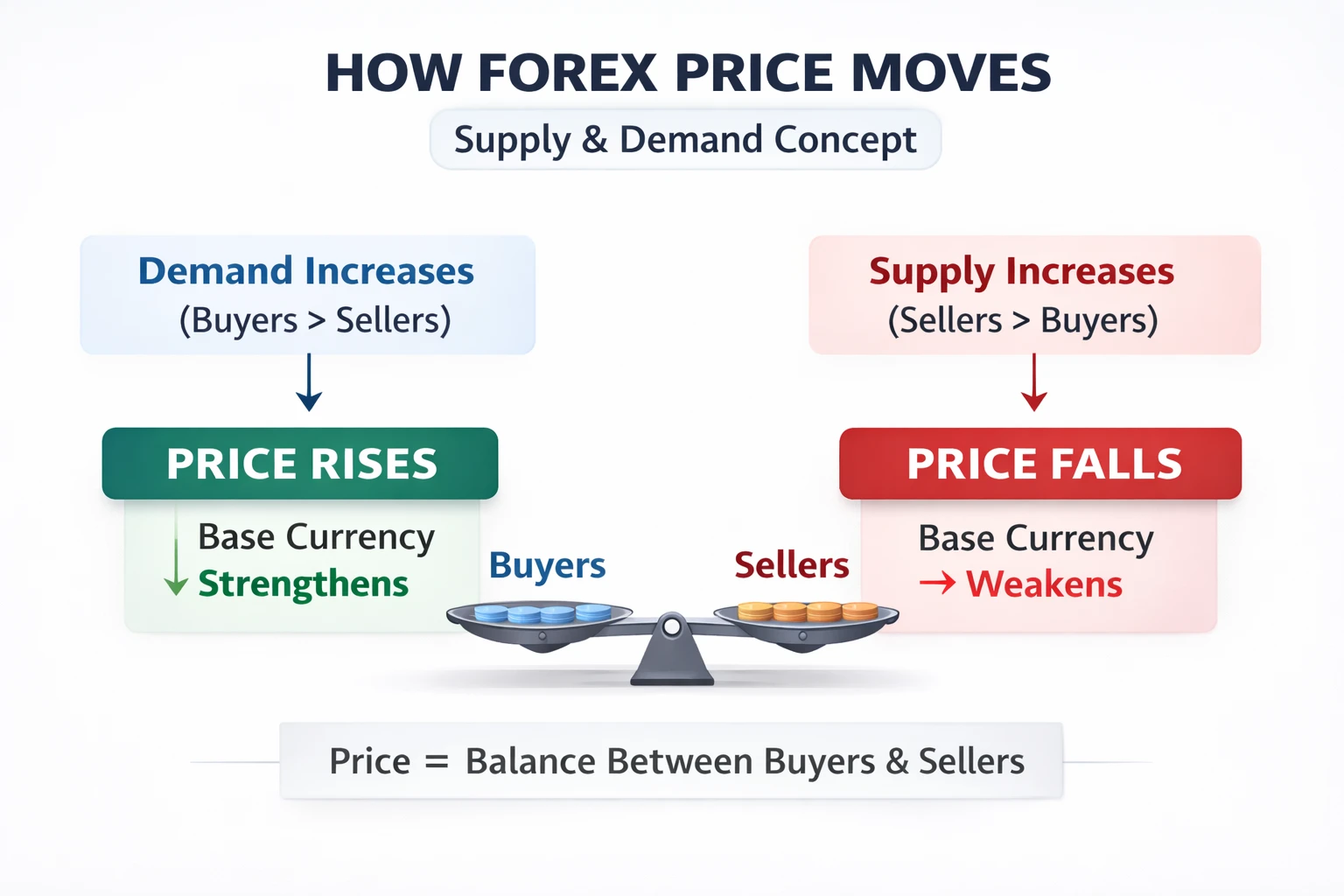
Exchange rates move based on supply and demand imbalance.
When demand exceeds supply, price rises. When supply exceeds demand, price falls.
6. Major Currency Pairs
Major currency pairs include:
- EUR/USD
- GBP/USD
- USD/JPY
- USD/CHF
- AUD/USD
- USD/CAD
- NZD/USD
7. Why They Are Called Major Pairs
They are called “major” because:
- They involve the world’s largest economies
- They have the highest trading volume
- Liquidity is very deep
- Institutional participation is strong
High liquidity generally results in smoother price movement.
8. Advantages of Trading Major Pairs
Major pairs offer:
- High liquidity
- Lower spreads
- More stable price movement
- Better execution quality
For beginners, this reduces structural trading risk.
9. What Exchange Rate Values Indicate
When you see:
EUR/USD = 1.1000
It does not mean one currency is absolutely strong. It means:
The relative value of Euro compared to Dollar at that moment.
Exchange rates reflect:
- Economic strength
- Interest rate differences
- Capital flows
- Global market expectations
Forex is always comparative.
10. How Exchange Rates Were Formed Historically
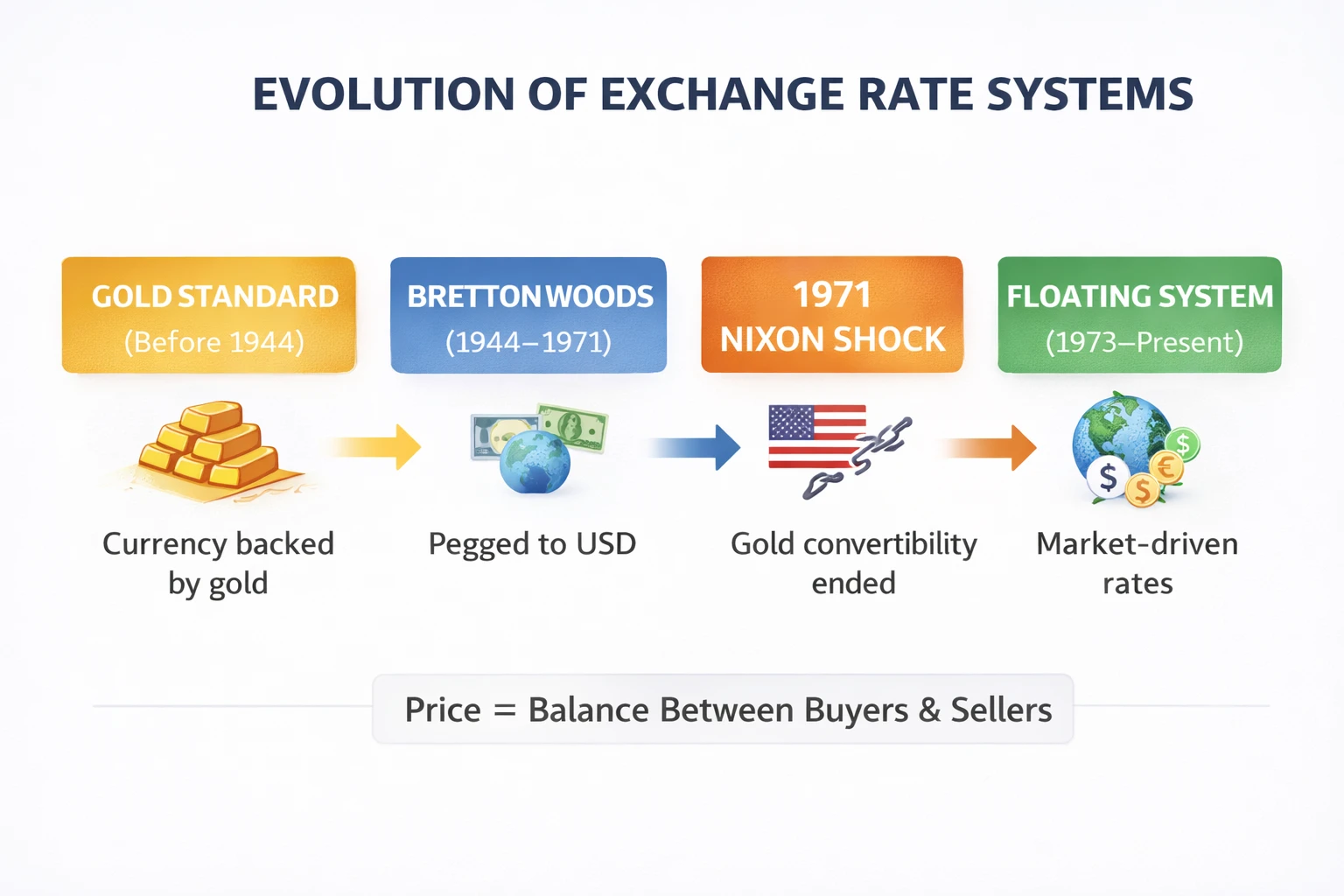
Understanding history explains why modern Forex works the way it does.
Timeline of Exchange Rate Evolution
Gold Standard (Before 1944)
↓
Bretton Woods System (1944–1971)
↓
Nixon Shock – 1971
↓
Floating Exchange Rate System (1973–Present)
Gold Standard Era
Currencies were backed by gold.
Exchange rates were derived mathematically.
Example:
1 GBP = 113 grains of gold 1 USD = 23.22 grains of gold
GBP/USD ≈ 4.86
Rates were calculated based on gold content.
Bretton Woods System (1944–1971)
- Currencies were fixed relative to the US Dollar
- The US Dollar was convertible to gold
- Governments maintained stable exchange rates
Rates were fixed, not floating.
1971 – Beginning of Floating System
The US ended gold convertibility.
After this, exchange rates began floating based on:
- Market supply and demand
- Economic conditions
- Capital flows
This created the modern Forex system.
11. First Historical EUR/USD Value
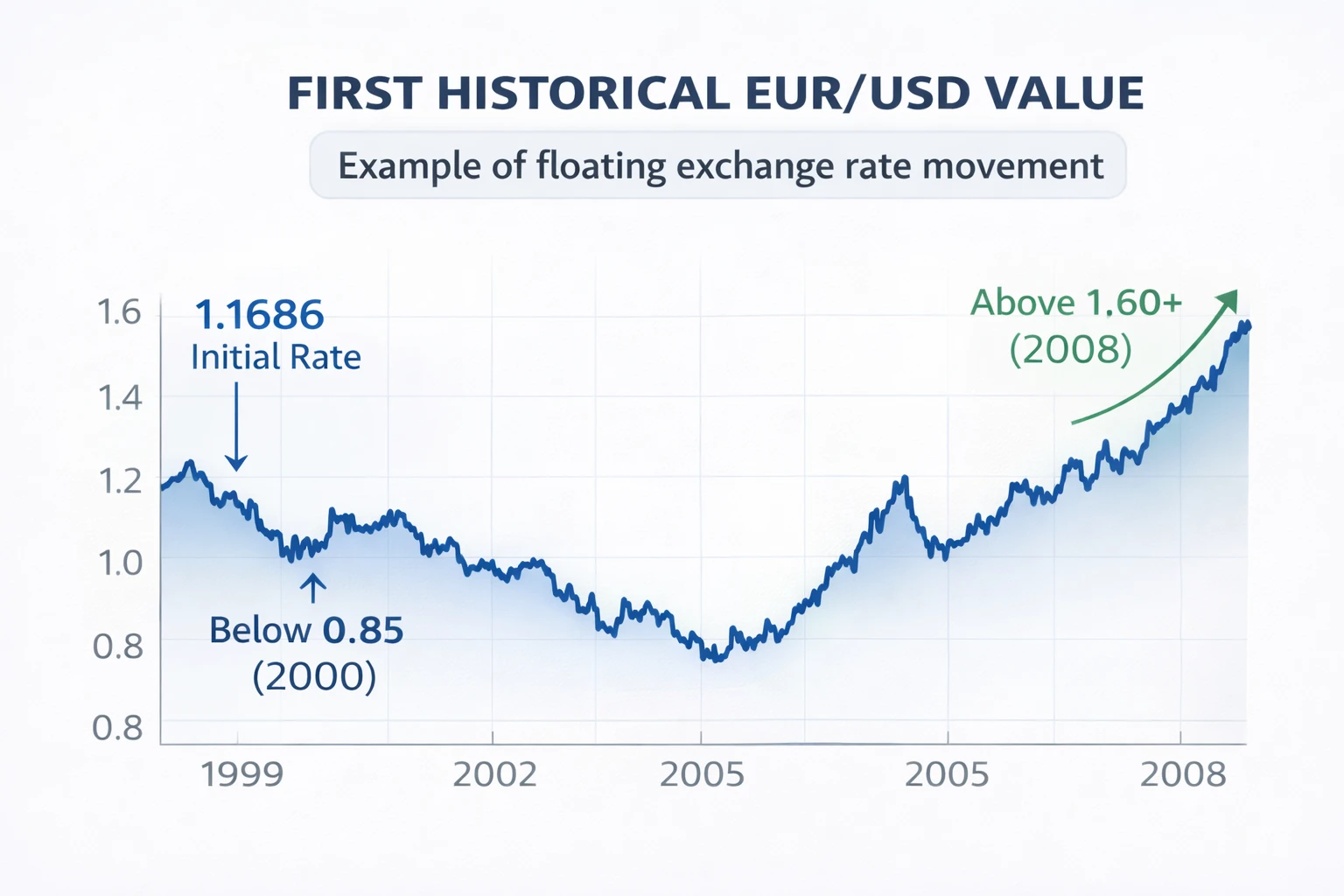
The Euro was introduced on January 1, 1999.
Initial reference rate:
EUR/USD = 1.1686
This rate was determined using:
- Historical exchange rates of European currencies
- Economic weighting of participating countries
It was not randomly selected.
Later:
- Exchange rates began reflecting macroeconomic changes
- Capital flows between Europe and the United States influenced price.
Reflecting macroeconomic changes and capital flows.
12. Early USD/INR Historical Structure
Before 1991:
- The Indian rupee operated under a tightly controlled exchange rate system.
During the 1991 economic crisis:
USD/INR moved from approximately ₹17–18 toward market-determined pricing.
In 1993, India adopted a more market-driven exchange rate system.
Today, USD/INR floats with central bank management to control extreme volatility.
13. Who Decides Exchange Rates Today?
Modern exchange rates are determined by:
- Global banks
- Institutional investors
- Corporations
- Hedge funds
- Central bank policies
No single authority directly sets floating exchange rates.
14. Why Forex Prices Move Every Day
Prices move due to:
- Interest rate expectations
- Inflation data
- Economic growth indicators
- Employment reports
- Central bank policy changes
- Global capital flows
- Political or geopolitical events
Markets respond primarily to expectations versus reality.
15. Market Psychology – The Hidden Force
Forex markets are expectation-driven.
Three key psychological layers:
- Expectations
- Surprise
- Positioning
If inflation is expected at 4% and actual is 4%, price may not move.
If expected 3% and actual 4%, strong movement may occur.
Markets price future expectations, not present headlines.
Understanding psychology reduces emotional decision-making.
16. Common Beginner Mistakes
- Trading without understanding market structure
- Overleveraging positions
- Ignoring economic fundamentals
- Chasing fast price movements
- Trading without risk management
- Overtrading during volatile events
- Expecting quick profits instead of consistent learning
Structured understanding reduces these mistakes.
FAQ
Who controls Forex prices?
Institutional supply and demand across global markets.
Why was EUR/USD initially 1.1686?
It was calculated using weighted conversion rates of Eurozone currencies.
Was USD/INR always floating?
No. It transitioned after India’s economic reforms in the early 1990s.
Why does price move opposite to news sometimes?
Because markets react to expectations, not headlines alone.
Is Forex predictable?
No market is fully predictable. Risk management is essential.

Written by
Trade Together Research
Trade Together Research is a professional market analysis team providing forex, gold, and crypto trading insights, technical analysis, and educational guides.. Learn more about our research team on the About page.