Seven Lessons for Successful Trading: Building the Right Mindset and Skills
Thu Apr 23 2026
Introduction
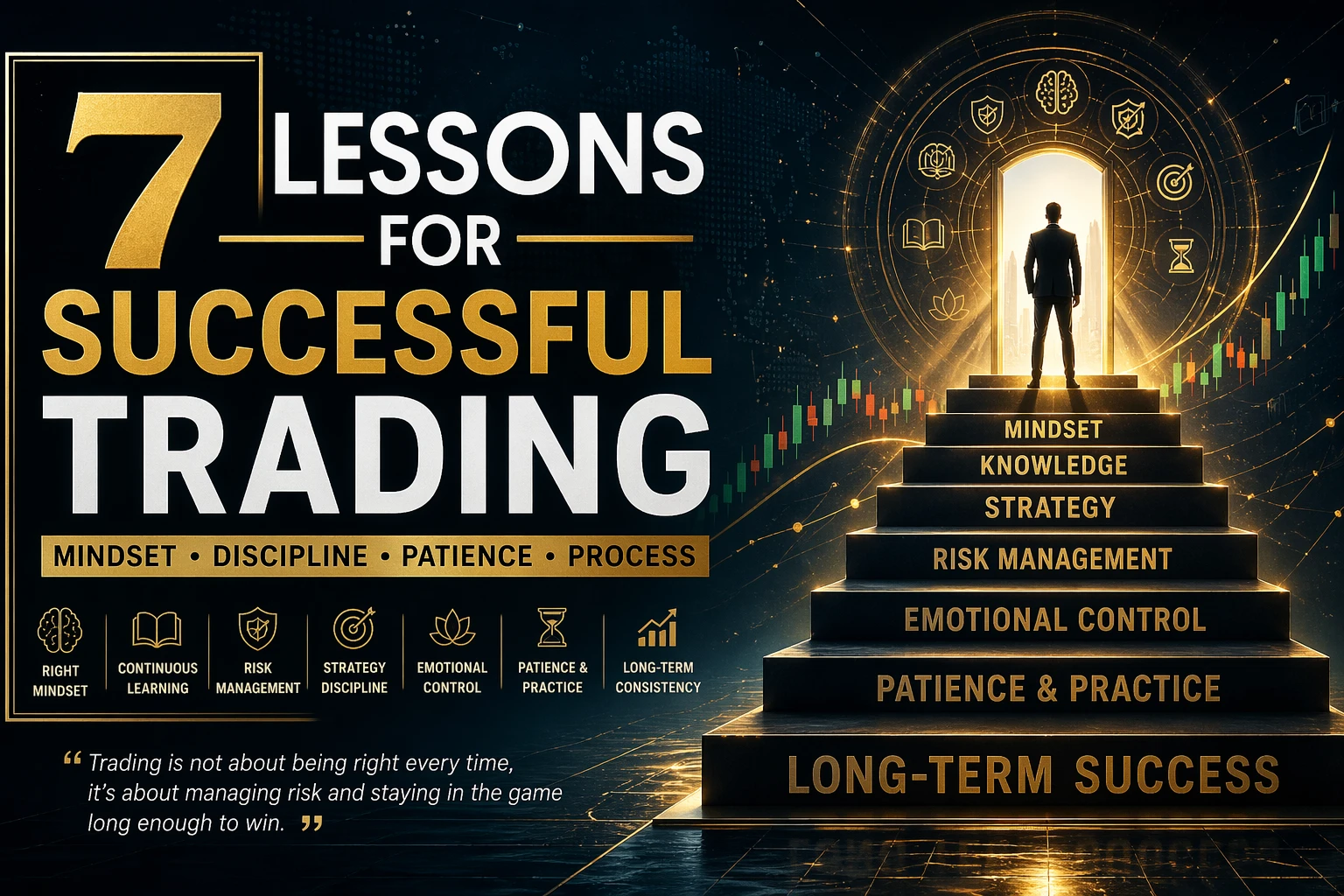
Many people enter trading with the goal of making money quickly. Social media, advertisements, and signal groups often promote the idea that trading is a fast way to become wealthy. However, experienced traders understand that trading is not about getting rich quickly—it is about developing skills, discipline, and a sustainable mindset.
This article is not about becoming a profitable trader overnight. Instead, it focuses on becoming a successful trader, which means building the right knowledge, habits, and psychological discipline required to survive in financial markets over the long term.
A successful trader focuses on developing skills and a winning mindset, rather than constantly chasing profits. When traders focus only on making money, they often take unnecessary risks, overtrade, and make emotional decisions after losses. Over time, this behavior usually leads to significant losses.
In contrast, traders who focus on learning market behavior, improving their strategy, and managing risk properly gradually develop the skills required to navigate financial markets more effectively.
If you are a trader reading our articles or courses, first ask yourself an honest question. If your goal is simply to make quick money without studying or understanding trading, then this platform may not be suitable for you. This website is built for people who want to learn trading seriously, understand how markets work, and develop real trading skills.
Lesson 1: Focus on Knowledge and Skill Development
The first step toward becoming a successful trader is gaining proper knowledge about how markets work.
Many beginners enter trading and start placing trades based purely on luck. Sometimes they may experience early profits, which can create the illusion that trading is easy. However, luck rarely produces consistent results.
Trading involves many concepts that require time to understand, including:
- Market structure
- Chart behavior
- Technical indicators
- Support and resistance
- Risk management
- Trading psychology
These concepts cannot be mastered overnight. Like any other profession, trading requires time, patience, and continuous learning.
There are many things to study from the beginning, such as understanding how charts behave, how markets move, how traders analyze price movements, and how trading strategies are built.
To help beginners learn trading step-by-step, we have created a structured course called Forex Foundations Masterclass, where all trading articles are arranged in a proper learning order from basic concepts to advanced topics.
You can explore the full course here: Forex Foundations Masterclass.
This readlist helps traders move through the educational journey from A-Z, starting with fundamentals and gradually progressing toward more advanced trading concepts. tradetogether.in Traders who invest time in studying the market and developing their analytical skills are more likely to survive in the long term compared to those who rely only on luck.
Lesson 2: There Is No Perfect Indicator or Strategy
Many beginner traders spend a lot of time searching for the perfect trading strategy or indicator that will produce winning trades every time.
In reality, no such strategy exists.
If a perfect indicator or strategy truly existed, every trader in the world would simply use it and make money consistently. Financial markets are complex systems influenced by many factors such as economic data, liquidity, central bank policies, and market sentiment.
Indicators should be seen as tools that support analysis, not as guaranteed solutions.
Indicators may help traders:
- Identify momentum
- Understand volatility
- Highlight possible support and resistance areas
But indicators alone cannot predict market movements with certainty.
Strategies also have limitations. Every strategy will experience both winning trades and losing trades.
Successful traders understand that losses are part of trading. Instead of trying to avoid losses completely, traders focus on managing risk and maintaining a positive risk-to-reward ratio over time.
Lesson 3: Avoid Jumping From One Strategy to Another
Another common mistake beginner traders make is constantly switching strategies.
A trader may try one strategy, experience a few losses, and then quickly move to another strategy. When that strategy also produces losses, they move to another one again.
This process of strategy hopping often prevents traders from developing real experience.
Every strategy requires:
- Testing
- Practice
- Refinement
When traders begin using a strategy, it may not perform perfectly at first. However, by applying the strategy repeatedly in real market conditions, traders can identify weaknesses and improve it over time.
By reviewing results and refining the approach, traders may eventually develop a strategy that works consistently for their own trading style.
Lesson 4: Start With Capital You Can Afford to Lose
Trading always involves risk, especially for beginners who are still learning.
For this reason, beginners should start trading with capital they can afford to lose without creating financial stress.
When traders start with large capital and strong expectations of quick profits, emotional pressure increases significantly. This pressure often leads to poor decision-making.
A more practical approach is:
- Start with smaller capital
- Focus on learning and practicing
- Increase capital gradually as consistency improves
This step-by-step process helps traders build confidence and discipline while reducing emotional pressure.
Lesson 5: Do Not Blindly Follow Trading Signals
Many traders rely heavily on signal groups or trading calls shared through Telegram, WhatsApp, or other social media platforms.
These signals usually tell traders when to buy or sell a particular asset.
Blindly following these signals can create several problems:
- Traders do not understand the reasoning behind the trade
- They do not develop their own analytical skills
- Risk management may be ignored
Educational trading platforms may share market insights or analysis, but these are intended as reference points rather than direct trading instructions.
For example, on the TradeTogether website, we share analysis and insights to highlight possible market levels or areas of interest. However, these should be used as reference points combined with your own analysis, not blindly followed.
The goal should always be learning how to analyze the market independently.
Lesson 6: Control Your Trading Emotions
Trading psychology is one of the most challenging aspects of trading.
When real money is involved, traders often experience emotions such as:
- Fear
- Greed
- Overconfidence
- Frustration
For example:
- After a profitable trade, traders may become overconfident and take excessive risks.
- After a losing trade, traders may try to recover losses quickly through impulsive trades.
Both behaviors can lead to poor decision-making.
One way traders attempt to control emotions is by following a structured trading plan that includes:
- A checklist for strategy conditions
- Pre-defined stop-loss levels
- A clear risk-to-reward ratio
For example, if a trader has a strategy with a 60% win rate and a 1:2 risk-reward ratio, there will naturally be losing trades within the system. Even if several losses occur consecutively, this does not necessarily mean the strategy is failing.
Understanding this statistical reality helps traders remain calm and avoid emotional over-trading.
In trading, it is also important to detach emotionally from money. Becoming overly emotional about profits or losses often leads to impulsive decisions that damage long-term performance.
Lesson 7: Patience and Practice Are Essential
Patience is one of the most important qualities in trading.
Many beginners study trading for a short period and then immediately start live trading. If they experience early losses, they may quickly conclude that trading does not work.
However, learning trading is similar to learning any other professional skill.
For example:
- Doctors spend years studying before practicing medicine.
- Engineers spend years learning technical knowledge.
- Athletes train for long periods before competing professionally.
Trading also requires time, observation, and continuous practice.
Unfortunately, many people enter trading expecting instant success. When reality does not match their expectations, they leave the market before developing the necessary skills.
Successful traders often spend significant time studying charts, reviewing trades, and improving their strategies.
With patience and practice, traders gradually build experience that improves their decision-making over time.
Conclusion
Successful trading is not about finding a perfect strategy or making quick profits.
Instead, it involves building a strong foundation of knowledge, discipline, patience, and risk management.
Traders who focus on improving their understanding of the market, controlling emotions, and practicing consistently are more likely to develop sustainable trading habits.
Financial markets are complex and constantly evolving. For this reason, traders should approach trading with realistic expectations and a commitment to continuous learning.
This article is intended for educational purposes only and should not be considered financial advice.
Frequently Asked Questions
Can beginners become successful traders?
Yes, beginners can become successful traders, but it requires consistent learning, patience, and disciplined risk management.
Is there a perfect trading strategy?
No trading strategy guarantees profits in every trade. Markets are influenced by many unpredictable factors.
Why do many traders fail?
Common reasons include unrealistic expectations, emotional trading, poor risk management, and lack of proper education.
How important is trading psychology?
Trading psychology is extremely important because emotional decisions can often override even the best trading strategies.

Written by
Trade Together Research
Trade Together Research is a professional market analysis team providing forex, gold, and crypto trading insights, technical analysis, and educational guides.. Learn more about our research team on the About page.