Do You Really Know Why Can’t Retail Traders Stay Profitable in Forex? What Is Really Happening? Every Trader Should Know This
Tue Sep 01 2026

The Problem Behind Consistent Forex Profitability
This is the most important article we have written on TradeTogether so far. It is not simply another study material or trading strategy. It is a logical way of looking at trading that we believe every trader should understand.
We have personally not seen this idea explained in this way before, and that is why we consider this article so important. We are sharing our understanding and perspective on something we believe many retail traders do not think about deeply enough.
Whether you are a beginner who wants to become a trader or an experienced trader who can make profits but struggles to remain consistently profitable, this article is for you.
You may already understand technical analysis, price action, fundamentals and risk management. You may have a strategy that you follow properly. You may even make profitable trades regularly.
But still, something doesn't add up.
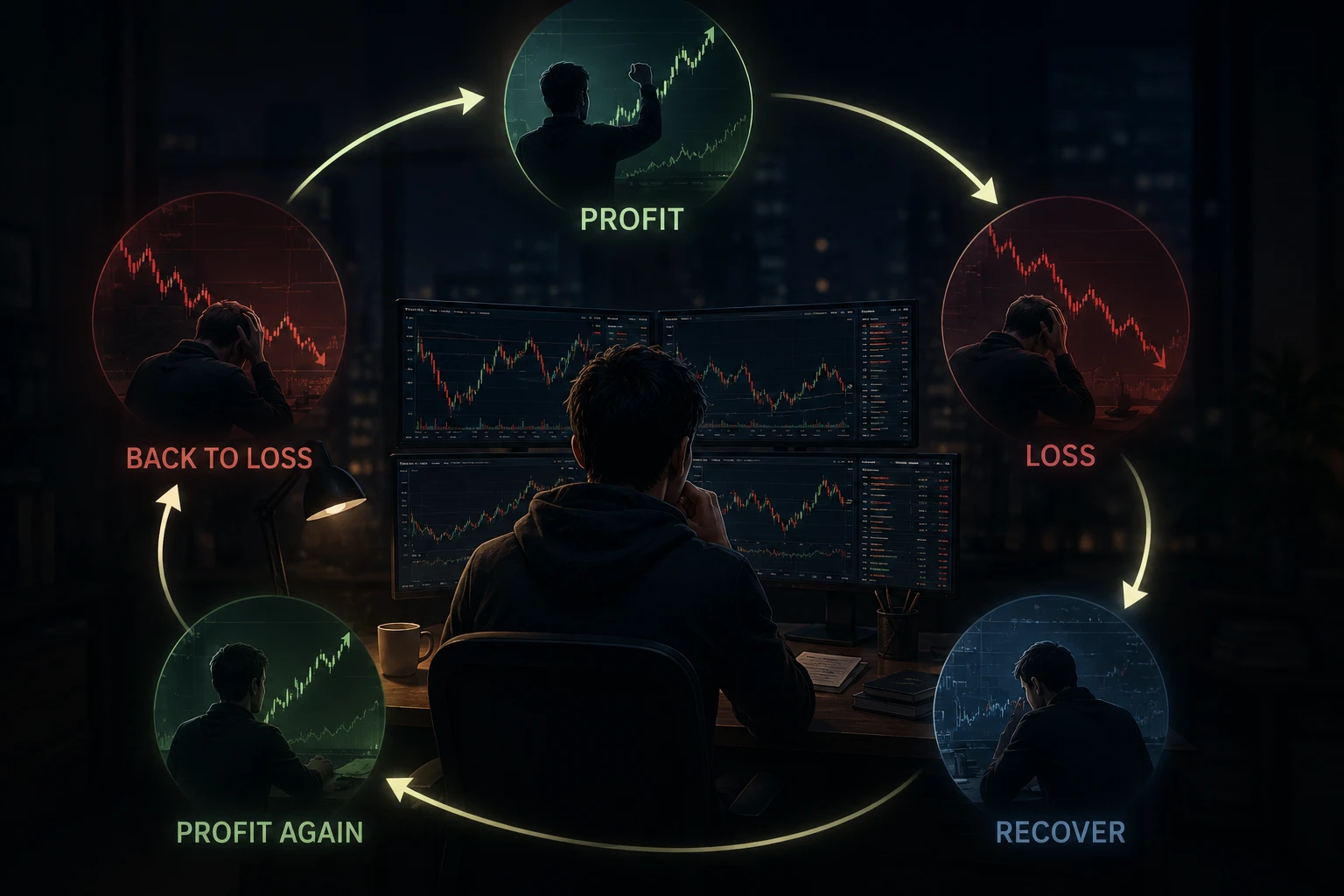
You make profits for a period, then losses come. You recover, make profits again, and eventually face another period of losses. At the end, your net profit may remain very small—or you may even end up with a loss.
So the real question is:
If we know how to trade, follow our strategy properly, manage risk correctly, and actually make profitable trades, why can't we remain profitable continuously?
That is what we want to explore in this article.
If you are serious about becoming a trader, or if you are already trading but still cannot understand why consistent profitability is so difficult, please spend these 10 minutes and read this article completely.
You may discover that the problem you have been trying to solve is not actually the problem you thought it was.
Why Is Consistent Profitability So Difficult for Retail Traders?
Many traders believe that once they master a strategy, understand risk-reward, learn proper position sizing, and control their risk, they will eventually become consistently profitable.
And yes, these things are important. A trader who understands the market and follows a strategy properly can absolutely make profits.
But there is a problem.
That strategy is not going to work the same way all the time.
A strategy can work very well under certain market conditions. We may follow it correctly and make money for a period of time. But after some time, the same strategy can start producing losses.
Then, after another period, it may start working again.
So the question is not simply whether a strategy works.
The real question is: How long will it work, and under what market conditions will it work?
This is where many retail traders start their journey with the wrong expectation.
They believe there must be something they have not found yet—a strategy, indicator, pattern, or method that will finally solve the problem.
They search for it through mentors, trading courses, institutions, social media and countless strategies.
They search for it through mentors, trading courses, institutions, social media and countless strategies.
It becomes almost like searching for a treasure:
“If we can just find that one strategy, and combine it with proper risk management, we can finally make money consistently.”
But that is not the reality we want you to understand.
The problem is not necessarily that you have not found the perfect strategy. The deeper problem is expecting one strategy to remain effective all the time.
That is the point from which we need to start looking at trading differently.
Why Can’t One Strategy Work Every Time?
Before we go further, we need to understand one simple thing:
A trading strategy is not the market.
A strategy is simply a set of rules designed to take advantage of a particular type of market behavior.
For example, one strategy may work better when the market is strongly trending. Another may work better when the market is moving sideways. Another may depend on short-term momentum.
But the market does not behave the same way all the time.
Sometimes buyers are stronger. Sometimes sellers are stronger. Sometimes neither side has enough strength and price moves sideways. Sometimes volatility becomes very high because of important news. At other times, the market moves very slowly.
Sometimes buyers are stronger. Sometimes sellers are stronger. Sometimes neither side has enough strength and price moves sideways. Sometimes volatility becomes very high because of important news. At other times, the market moves very slowly.
This happens because the balance between supply and demand keeps changing.
And when the market environment changes, the conditions that a strategy depends on can also change.
A Simple Example
Imagine a strategy that performs well when price moves strongly in one direction.
During a strong trend, the strategy may produce good results.
The rules are followed correctly and profits are made.
Then the market changes.
Price starts moving sideways instead of trending.
The same strategy is still being followed, but now it starts producing more losses.
Did the trader suddenly become a bad trader?
Not necessarily.
Did the strategy automatically become a bad strategy?
Not necessarily.
The market condition changed.
Later, if strong trending conditions return, the same strategy may start performing well again.
So we can see a simple cycle:
Favorable conditions → strategy performs well
Conditions change → strategy struggles
Conditions become favorable again → strategy may perform well again
A Strategy Can Have an Edge Without Working All the Time
A strategy can have a genuine statistical edge and still experience losing periods.
Having an edge does not mean winning every trade, every month, or every market condition.
It means that over a sufficiently large sample, under the conditions where the strategy has an advantage, its results may be positive.
Therefore, the important questions are not only:
“Does our strategy work?”
They are also:
“When does it work?”
“When does it struggle?”
“What happens when our strategy enters a period where it does not perform well?”
The Problem With Searching for the Perfect Strategy
This is why many traders spend years searching for the perfect strategy.
They believe there must be one strategy somewhere that works in every market condition.
But the market is continuously changing because supply, demand, participants, information, liquidity and volatility are continuously changing.
So expecting one fixed set of rules to perform equally well forever is unrealistic.
A strategy can have an edge without having a permanent edge.
And this leads to the next question:
If one strategy can go through periods of weakness, should a trader depend entirely on one strategy?
If One Strategy Can’t Always Work, How Do Institutions Stay Profitable?
The problems faced by retail traders are not completely different from the problems faced by institutions.
Institutions also have strategies that lose money. They also experience drawdowns. Their strategies can also go through periods when they perform well and periods when they perform poorly.
The difference is not that they have discovered one perfect strategy.
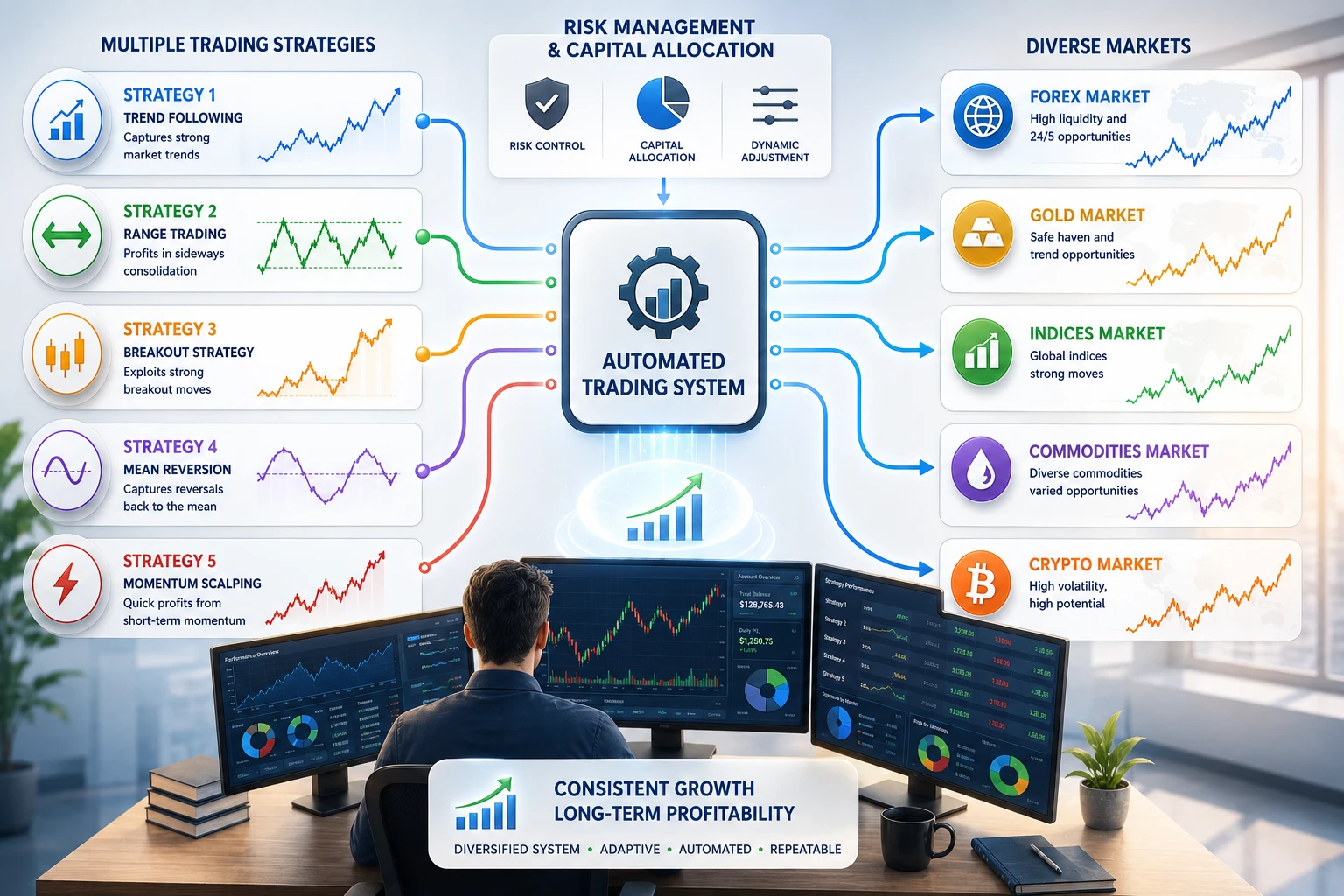
Large funds and systematic trading firms can operate multiple strategies at the same time. These strategies may be automated and designed to respond to different types of market conditions.
One strategy may perform well during one period, while another may perform better during a different period.
The important idea is that the portfolio does not have to depend entirely on one strategy.
A Simple Example
Imagine a portfolio with five different strategies.
- Strategy A is performing strongly.
- Strategy B is performing normally.
- Strategy C is going through a weak period.
- Strategy D is improving.
- Strategy E is also struggling.
Instead of permanently giving every strategy the same allocation, a portfolio approach can evaluate their performance and risk and adjust the allocation according to predefined rules.
- A stronger-performing strategy may receive greater weight.
- A strategy experiencing sustained deterioration may receive less weight.
- Another strategy may receive greater allocation if it begins demonstrating stronger and more consistent performance.
The important point is that the allocation itself can evolve.
It is not about predicting which strategy will work forever.
It is about recognizing that strategies can move through different periods of performance and managing the overall portfolio accordingly.
What Does This Mean for a Retail Trader?
A retail trader does not necessarily need to search for one strategy that will work forever.
Instead, they can think about building a collection of strategies.
A possible process is:
Find a strategy → Backtest it → Study its historical behavior → Test its robustness → Automate it → Monitor it → Add another strategy → Repeat.
The trader can then divide available capital among different strategies rather than depending entirely on one approach.
But simply having many strategies is not enough.
Each strategy needs to be tested properly. A trader should understand its historical performance, drawdown, volatility, consistency, sensitivity to market conditions, and relationship with the other strategies.
Capital allocation should also be based on predefined rules rather than emotions or a few recent winning trades.
If one strategy enters a sustained period of weakness, its allocation can potentially be reduced according to those rules.
If another strategy continues to meet the required conditions, its allocation can potentially receive greater weight.
And when the market changes again, the allocation can change again.
"The idea is to stop expecting one strategy to work forever and instead build a system that can respond to changing strategy performance."
This does not guarantee profitability. A portfolio can still experience losses, and several strategies can underperform at the same time. But it changes the way the problem of consistency is approached.
Stop Trying to Master the Market
There is another important thing every trader needs to understand.
"You cannot master the market."
Think about skills such as cycling or swimming. You can learn them, practice them, and eventually become highly skilled. The basic principles remain relatively stable.
The market is different.
The market is continuously evolving.
Participants change. Their behavior changes. Supply and demand change. Volatility changes. Technology changes. Information changes. New participants enter, and existing participants adapt.
So there is no final point where you can say:
“Now we have mastered the market.”
We can become highly skilled at analyzing and responding to the market, but we cannot completely master something that is continuously changing.
Don't Try to Predict Everything. Learn to React.
This changes the way we should think about trading.
If we build one strategy and expect it to work continuously, we are effectively making an assumption about how the market will behave in the future.
We are saying:
“When this condition happens, the market will behave in this particular way.”
Sometimes it will.
Sometimes it won't.
Instead of trying to predict what the market will do all the time, a different approach is to react to what the market is actually doing.
This is where a multi-strategy approach becomes relevant.
We don't need every strategy to work at every moment.
We need to understand which strategies are responding well to the current environment and which ones are not.
One strategy may be better suited to the conditions today.
Another may become more suitable later.
Another may remain inactive or underperform for a period.
The objective is not to force the market to fit our strategy.
"The objective is to build a system that can respond when the market changes."
How We Approach the Market at TradeTogether
This is also how we look at the market at TradeTogether.
We don't believe that one strategy should be followed blindly forever.
"The market evolves, so our approach has to evolve with it."
We continuously study market behavior, look at changing conditions, and analyze what is currently happening rather than forcing every market into the same strategy.
Our market analysis is built around understanding the conditions that are actually present and adapting our analysis as those conditions change.
You can follow our ongoing market analysis and see how we approach changing market conditions through our TradeTogether Instagram profile
We are also working toward automation, where strategies can be systematically tested, backtested, monitored and executed according to predefined rules.
The purpose of automation is not to create a machine that guarantees profits.
It is to make it possible to test, execute and monitor systematic strategies in a way that a single person could not realistically do manually across many markets and strategies.
This is the philosophy behind what we are building at TradeTogether:
" Don't search endlessly for one perfect strategy.
Study the market. Build strategies. Test them. Automate them where appropriate. Monitor them. Understand when they work and when they struggle. And build a framework that can adapt as the market evolves. "
This is a more realistic way to think about trading than expecting one strategy to carry an entire trading journey forever.
Frequently Asked Questions
Can one Forex strategy work forever?
No strategy should be assumed to perform identically forever. Market conditions, volatility, liquidity, participants and other factors change, so the performance of a strategy can change over time.
Does a losing period mean that a strategy is broken?
Not necessarily. A strategy with a genuine historical edge can experience losing periods. The important question is whether the strategy remains robust under appropriate testing and whether its current behavior remains within the conditions for which it was designed.
Is using multiple strategies automatically safer?
No. Multiple strategies do not automatically eliminate risk. Strategies can become correlated and several systems can lose money at the same time. Diversification needs to be tested and managed carefully.
Why is automation useful for a multi-strategy approach?
Automation can help execute predefined rules, collect performance data and monitor multiple systems simultaneously. It does not guarantee better results and still requires proper testing, risk controls and ongoing supervision.
Can retail traders use an institutional-style approach?
Retail traders can adopt some principles used in systematic portfolio management, such as diversification across strategies, systematic testing, automation and structured capital allocation. However, retail traders generally do not have the same resources, infrastructure or execution capabilities as large institutions.
Conclusion
The goal of trading should not be to find one strategy that works forever.
The market changes, and every strategy can go through periods of strength and weakness. Instead of trying to master or constantly predict the market, we believe traders should learn to adapt and react to changing conditions.
A properly tested and risk-managed collection of strategies can provide a more flexible approach than depending entirely on one strategy.
"We don't need to predict everything. We need to build a system that can respond when things change.'
If you are building your Forex knowledge, explore our Forex Foundation Masterclass, structured from the basics to more advanced concepts.
For trading psychology and discipline, explore our Trader Psychology Series

Written by
Trade Together Research
Trade Together Research is a professional market analysis team providing forex, gold, and crypto trading insights, technical analysis, and educational guides.. Learn more about our research team on the About page.