Is Forex Centralized or Decentralized? OTC Market Structure Explained for Beginners - Chapter 4
Sun Mar 01 2026
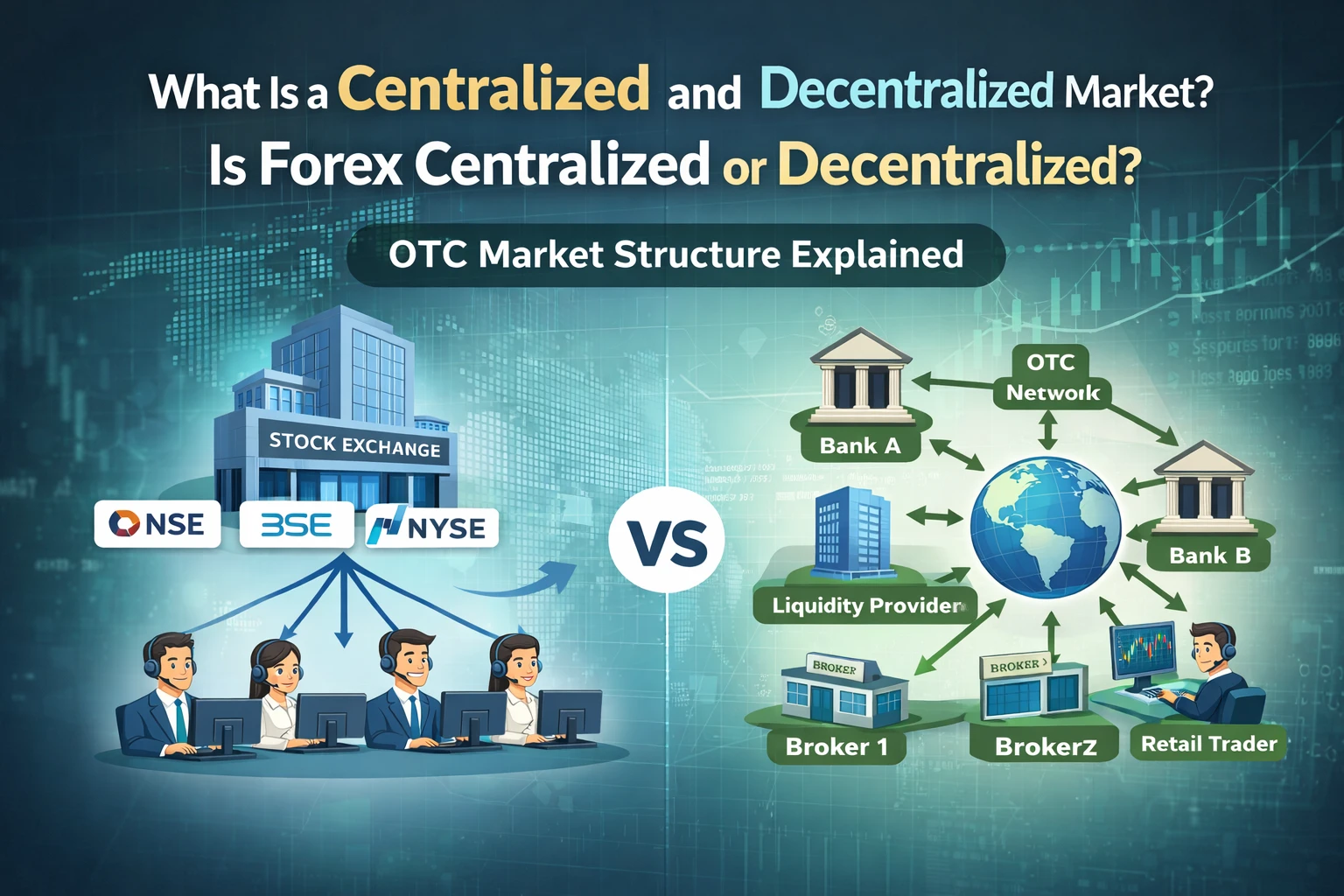
In Chapter 3, we discussed how to start forex trading safely using demo, real, and funded accounts. ( https://tradetogether.in/articles/start-forex-trading-safely-beginners-demo-real-funded )Now that you understand how to enter the market, it is essential to understand how the market itself is structured. Before focusing on strategies or execution, traders must clearly understand whether forex operates as a centralized or decentralized system.
Many beginners assume that all financial markets operate like stock exchanges — with one central platform where every trade is recorded and matched. However, the foreign exchange (forex) market functions differently.
Understanding whether forex is centralized or decentralized is not just theoretical knowledge. It directly affects liquidity, spreads, execution quality, volatility behavior, and risk management decisions.
This chapter explains how the forex market is structured, how pricing works in an over-the-counter (OTC) system, how it compares to centralized stock exchanges in India and the United States, and what traders should realistically understand before participating.
1. What Is a Centralized vs Decentralized Market?
What Is a Centralized Market?
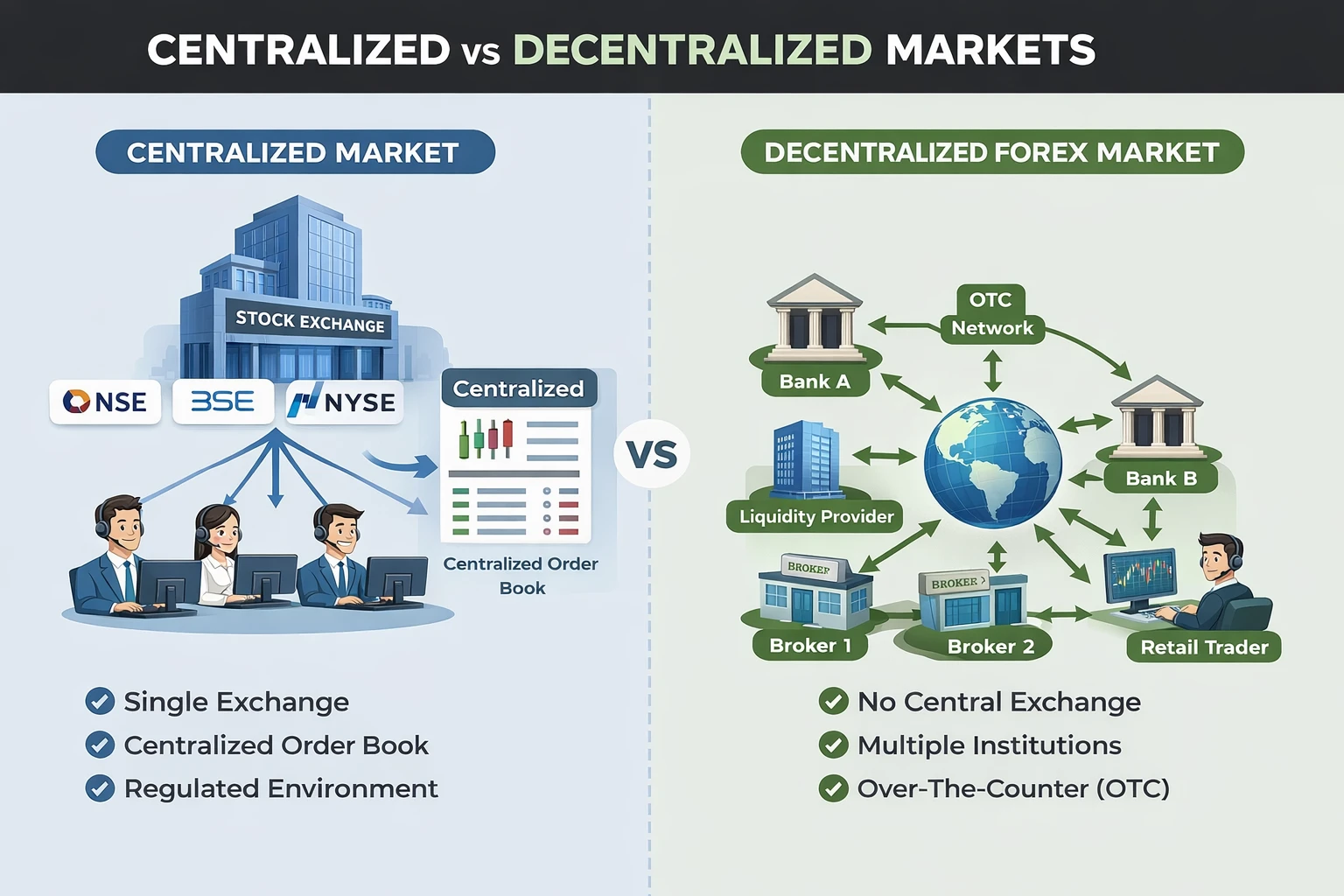
centralized market operates through:
- A single organized exchange where buyers and sellers meet
- A centralized matching system that records all transactions
- A regulated infrastructure that standardizes trading rules
For example, Stock exchanges such as :
- NSE
- NYSE
- BSE
In these systems:
- All orders are matched within a central exchange
- A single order book determines price discovery
- Trades are recorded through the exchange infrastructure
This structure creates centralized transparency and standardized regulation.
What Is a Decentralized Market?
A decentralized market:
- Has no single central exchange
- Operates through networks of financial institutions
- Allows participants to quote prices independently
The forex market is decentralized.
What Traders Should Learn
Centralized markets concentrate pricing in one location. Decentralized markets distribute pricing across institutions.
Neither structure guarantees profitability. What matters is how traders manage leverage, volatility, and position sizing.
2. How the Forex Market Is Structured (OTC Framework)
What Is the Forex Market?
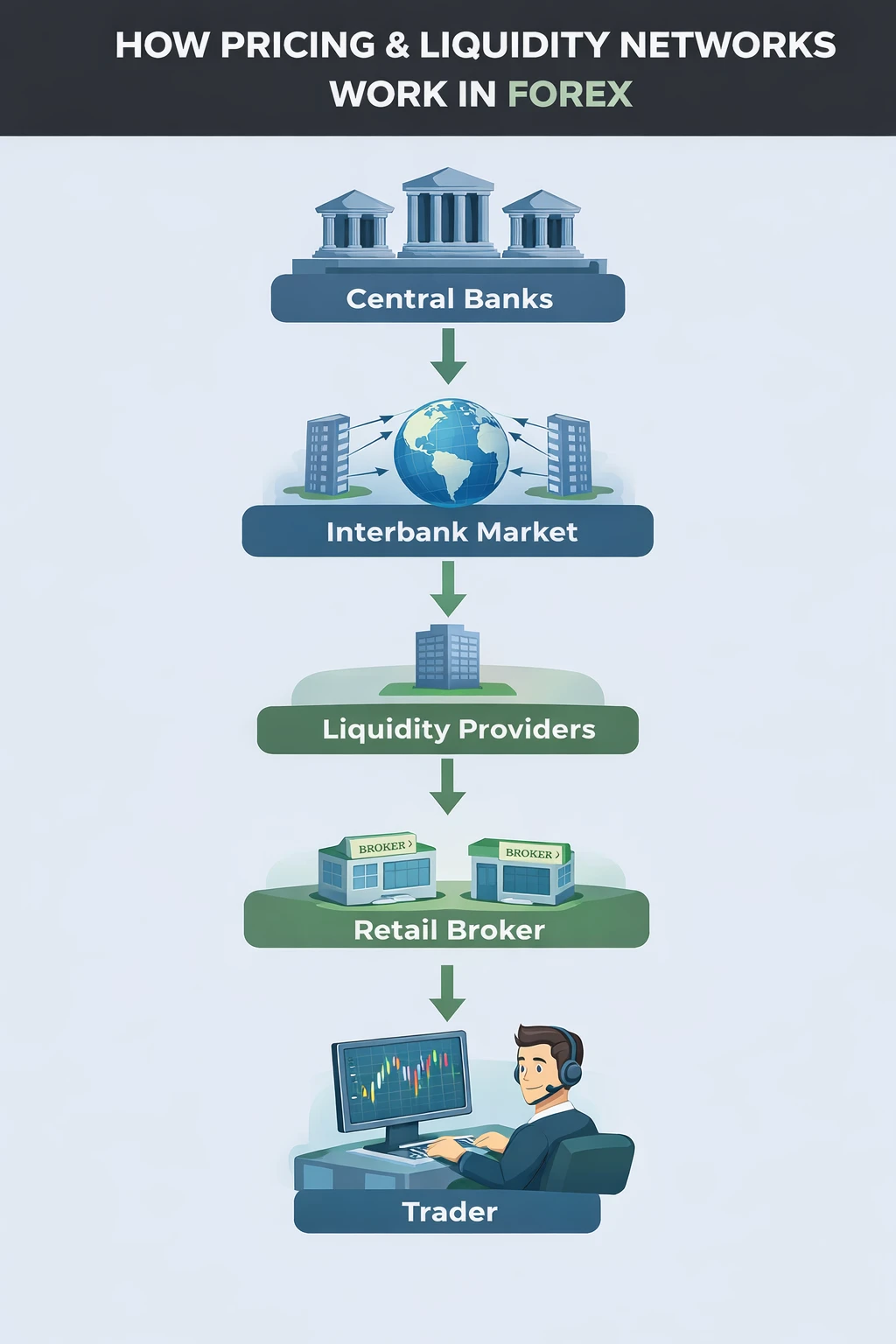
The forex market is a global OTC network consisting of:
- Major international banks
- Liquidity providers
- Institutional traders
- Brokers
- Retail traders
There is no single “forex exchange.”
Instead, pricing originates from the interbank market — a global network where major banks quote bid and ask prices to one another.
Why Forex Operates Decentralized
Currencies trade across global sessions:
- Asian trading session
- European trading session
- North American trading session
Liquidity flows continuously across time zones, creating a 24-hour market.
Because pricing is aggregated from multiple liquidity providers, different brokers may display slightly different quotes.
What Traders Should Learn
In a decentralized OTC market:
- Prices come from multiple liquidity providers rather than a single exchange
- Brokers aggregate quotes from banks and institutions
- Execution quality depends on liquidity connections and infrastructure
Understanding structure improves execution awareness — but risk management remains the primary protection tool.
3. How Pricing and Liquidity Networks Work in Forex
How Are Forex Prices Formed?
Forex prices are determined by:
- Interbank liquidity providers
- Institutional order flow
- Broker liquidity aggregation
Unlike centralized stock exchanges with one official order book, forex relies on distributed liquidity networks.
Why Liquidity Changes Throughout the Day
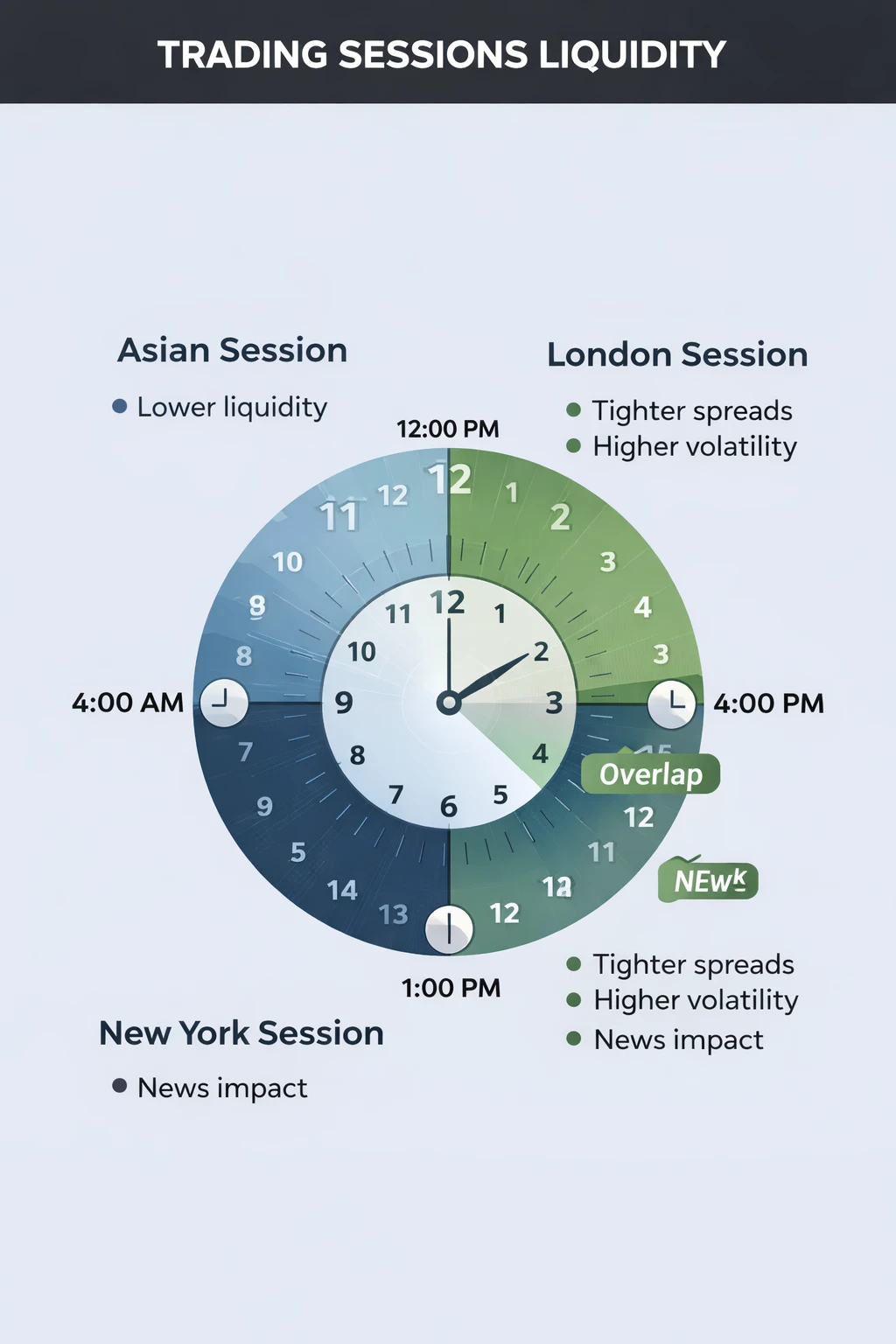
Liquidity depends on:
- Global trading sessions
- Institutional participation
- Macroeconomic news releases
For example:
- London session typically provides the highest liquidity
- Asian session may experience lower volatility
- News events can temporarily expand spreads
Practical Risk Example
If a trader risks 1% per trade with a defined stop-loss:
- losing streak remains manageable
- Account drawdown stays limited
- Recovery remains statistically possible
If a trader risks 8–10% per trade:
- A few losses can cause severe drawdown
- Emotional pressure increases significantly
- Account survival becomes difficult
Market structure influences execution conditions — but position sizing determines survival.
4. Stock Market vs Forex: Structural Comparison
| Feature | Stock Market (Centralized) | Forex Market (Decentralized) |
|---|---|---|
| Trading Venue | Single exchange (e.g. NSE, NYSE, BSE) | OTC interbank network |
| Order Book | Centralized order book | Distributed liquidity pools |
| Price Feed | Unified price discovery | Aggregated pricing from multiple liquidity providers |
| Trading Hours | Fixed exchange hours | 24-hour global market |
| Participants | Retail traders, institutions, listed companies | Banks, institutions, brokers, retail traders |
| Execution Path | Orders routed through exchange infrastructure | Orders routed through broker to liquidity providers |
| Regulation | Central exchange authority | Multiple regulatory jurisdictions |
| Liquidity Source | Exchange order book | Interbank market liquidity |
Why This Matters
Centralized exchanges provide:
- Transparent order books
- Standardized regulation
- Unified price discovery
Decentralized forex provides:
- Multiple liquidity providers
- Distributed pricing
- Continuous global trading
However, neither system removes uncertainty. Volatility and risk are present in both structures.
5. Basic Execution Flow in a Decentralized Forex Market
What Happens When You Place a Trade?
-
You submit an order through your trading platform.
-
The broker receives the order.
-
The order may be routed internally or to external liquidity providers.
-
A liquidity provider fills the trade.
Because forex is decentralized:
- Multiple liquidity sources influence pricing
- Brokers aggregate quotes from institutions
- Execution speed depends on infrastructure
What Traders Should Learn
Execution flow basics are part of structural education.
However, long-term performance depends more on:
- Risk management
- Position sizing discipline
- Emotional control
Understanding structure builds awareness — but discipline preserves capital.
Frequently Asked Questions
1. Is forex completely decentralized?
Yes. Forex operates as an OTC market without a single central exchange like NSE or NYSE.
2. Is the stock market centralized?
Most stock markets operate through centralized exchanges with consolidated order books.
3. Does decentralization mean forex is unregulated?
No. Brokers can still be regulated by national financial authorities depending on jurisdiction.
4. Why do different brokers show slightly different prices?
Because pricing comes from different liquidity providers within the decentralized network.
5. Is decentralized trading riskier?
Risk primarily comes from leverage and position sizing — not from decentralization alone.
Conclusion
The forex market is decentralized, operating through a global OTC network of banks, institutions, and liquidity providers. Unlike centralized stock exchanges such as NSE, BSE, NYSE, or NASDAQ, forex pricing is distributed rather than concentrated in one matching engine.
This structure affects spreads, session-based liquidity, and execution variability. However, successful trading depends far more on disciplined risk management, controlled leverage, and capital preservation than on structural differences alone.
This article is provided for educational purposes only and does not constitute financial advice.

Written by
Trade Together Research
Trade Together Research is a professional market analysis team providing forex, gold, and crypto trading insights, technical analysis, and educational guides.. Learn more about our research team on the About page.