How to Start Forex Trading Safely for Beginners Using Demo, Real & Funded Accounts – Complete Starter Guide - Chapter 3
Sat Feb 28 2026

Starting forex trading without a clear structure often leads to confusion, over-leverage, and unnecessary losses. After understanding what forex is and how trading mechanics work, the next critical step is knowing how to start safely and realistically.
Before choosing your starting path, make sure you understand the foundational concepts covered in Chapter 1: What Is Forex and How Currency Pairs Work ( https://tradetogether.in/articles/forex-course-for-beginners-chapter-1-what-is-forex-and-how-currency-pairs-work ) and Chapter 2: How Forex Trading Works Inside Your Account (Lots, Leverage, Margin & Risk Explained) ( https://tradetogether.in/articles/forex-trading-mechanics-lots-leverage-margin-explained) . Those chapters explain market structure and trading mechanics — this chapter focuses on how to begin applying them safely.
Should you begin with a demo account? Open a small real account? Attempt a funded (prop firm) challenge?
Each path carries different levels of capital risk, psychological pressure, and structural rules. This guide explains the safest way to begin forex trading while emphasizing risk management, probability thinking, and capital preservation.
1. Understanding Your Three Starting Options
Before placing your first trade, you must understand the three primary ways to enter the forex market:
- Demo account
- Small real trading account
- Funded (prop firm) account
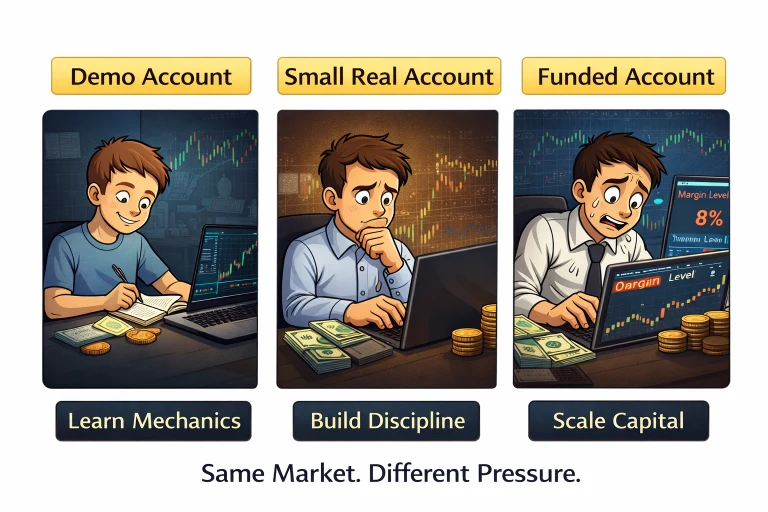
Each option serves a different purpose in a trader’s development.
2. Demo Account: Learning Without Financial Risk
What Is a Demo Account?
A demo account simulates real market conditions using virtual funds. Prices move in real time, spreads apply, and margin behaves similarly to live trading — but no real money is at risk.
Pros of a Demo Account
- Learn how trading platforms work
- Practice placing and managing trades
- Understand spreads, lots, and leverage
- Test strategies without financial risk
Cons of a Demo Account
- No emotional pressure from real money
- Execution conditions may differ slightly
- Overconfidence can develop easily
What Beginners Should Learn
Use demo trading to master:
- Order execution and platform navigation
- Basic risk management
- Position sizing and stop-loss placement
- Strategy testing and journaling
Demo trading builds technical skill — not emotional resilience.
3. Real Trading Account: Developing Emotional Discipline
What Is a Real Account?
A real trading account involves using your own capital through a regulated broker. Profits and losses directly affect your balance.
Pros of a Real Account
- Real market psychology and emotional discipline
- Real execution and market conditions
- Stronger accountability for risk management
Cons of a Real Account
- Financial losses are possible
- Emotional pressure increases
- Over-leveraging can destroy accounts quickly
Practical Risk Example
you deposit $1,000 and risk 1% per trade:
- Maximum loss per trade = $10
- Losing streaks remain manageable
- Account survival probability increases
This prevents a normal losing streak from destroying the account.
What Beginners Should Learn
Start small. Focus on survival, not fast growth. Risk 0.5%–1% per trade until consistency is proven.
Capital preservation is more important than early profit.
4. Funded (Prop Firm) Account: Structured but Strict
What Is a Funded Account?
Funded accounts are offered by proprietary trading firms. Traders pass an evaluation to access larger capital while following strict risk rules.
Common restrictions include:
- Maximum daily drawdown limits
- Overall account drawdown limits
- Profit targets during evaluation
- Minimum trading days
Pros of a Funded Account
- Access to larger trading capital
- Reduced personal financial risk
- Profit-sharing opportunities
Cons of a Funded Account
- Strict rule violations can fail the account
- Evaluation fees are required
- Psychological pressure is high
What Beginners Should Learn
Funded trading is not easier — it is more structured.
Even strong strategies fail if:
- Risk management is ignored
- Position sizes become too large
- Emotional discipline breaks down
Funded trading rewards discipline, not aggression.
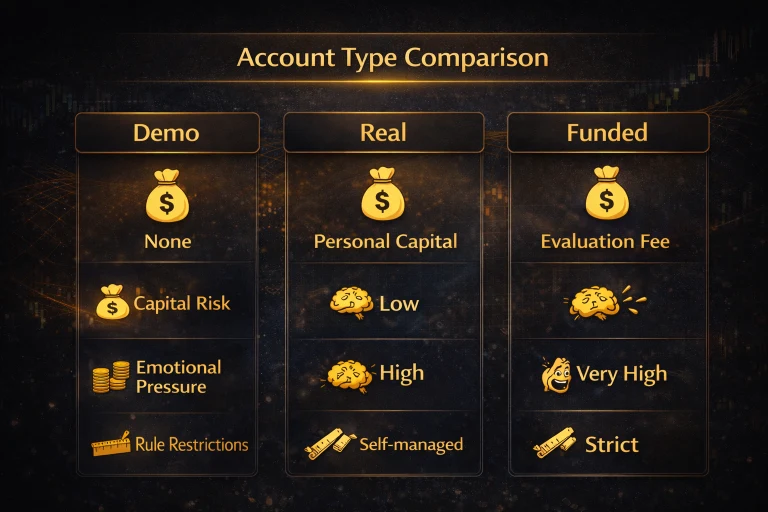
5. Side-by-Side Comparison
| Feature | Demo Account | Real Account | Funded Account |
|---|---|---|---|
| Capital Used | Virtual funds | Your own money | Firm’s capital after evaluation |
| Financial Risk | No real risk | Direct personal loss possible | Evaluation fee risk |
| Primary Purpose | Learning platform mechanics | Building emotional discipline | Scaling capital with strict rules |
| Psychological Pressure | Very low | Moderate to high | High due to strict limits |
| Risk Management Importance | Often ignored by beginners | Critical for survival | Strictly enforced by rules |
| Profit Potential | None (simulated) | Limited by personal capital | Higher due to larger funded capital |
| Typical Restrictions | None | Broker margin rules | Daily drawdown, max drawdown, profit targets |
| Best For | Beginners learning execution | Developing real trading discipline | Consistent traders with proven risk control |
6. Recommended Beginner Progression Path
For most beginners, a structured progression reduces failure probability:
- Start with demo trading to learn mechanics.
- Transition to a small real account to build emotional control.
- Consider funded accounts only after demonstrating consistent risk discipline.

Skipping steps increases the risk of capital destruction.
Forex markets are driven by liquidity flows, central bank policy shifts, volatility cycles, and macroeconomic events. Without structured risk control, even good analysis cannot protect capital.
Frequently Asked Questions
1. Should beginners skip demo trading?
It is generally safer to understand execution mechanics before risking real money.
2. Is a funded account safer than a real account?
It reduces personal capital exposure but introduces strict drawdown rules and psychological pressure.
3. How much should I start with in a real account?
An amount you can afford to lose without financial stress, while risking a small percentage per trade.
4. Can demo trading make me consistently profitable?
It builds technical skill but does not test emotional discipline.
5. Is forex trading guaranteed income?
No. Forex trading involves substantial risk and uncertain outcomes.
Continue Your Forex Foundation
To build a complete understanding of forex trading, read these chapters in sequence:
Reading them in order ensures clarity from market structure → account mechanics → execution path.
Conclusion
Starting forex trading safely requires structure, not urgency.
Long-term success in forex depends on probability thinking, controlled position sizing, and capital preservation — not speed or aggression.
This content is for educational purposes only and does not constitute financial advice.

Written by
Trade Together Research
Trade Together Research is a professional market analysis team providing forex, gold, and crypto trading insights, technical analysis, and educational guides.. Learn more about our research team on the About page.