Chapter 20: How Chart Patterns Work in Price Action Trading – Part 4
Sun Apr 19 2026
Introduction
In the previous chapters of this price action trading series, we explored several important concepts that help traders understand market behavior.
We began with the fundamentals of price action trading, which explains how traders analyze raw price movements without relying heavily on technical indicators.
You can start with the first chapter here:
Price Action Trading Basics: Chapter 20: Price Action Trading Explained for Forex Beginners (Chart Reading Guide) – Part 1.
After learning the fundamentals, we explored different types of chart patterns used in price action analysis.
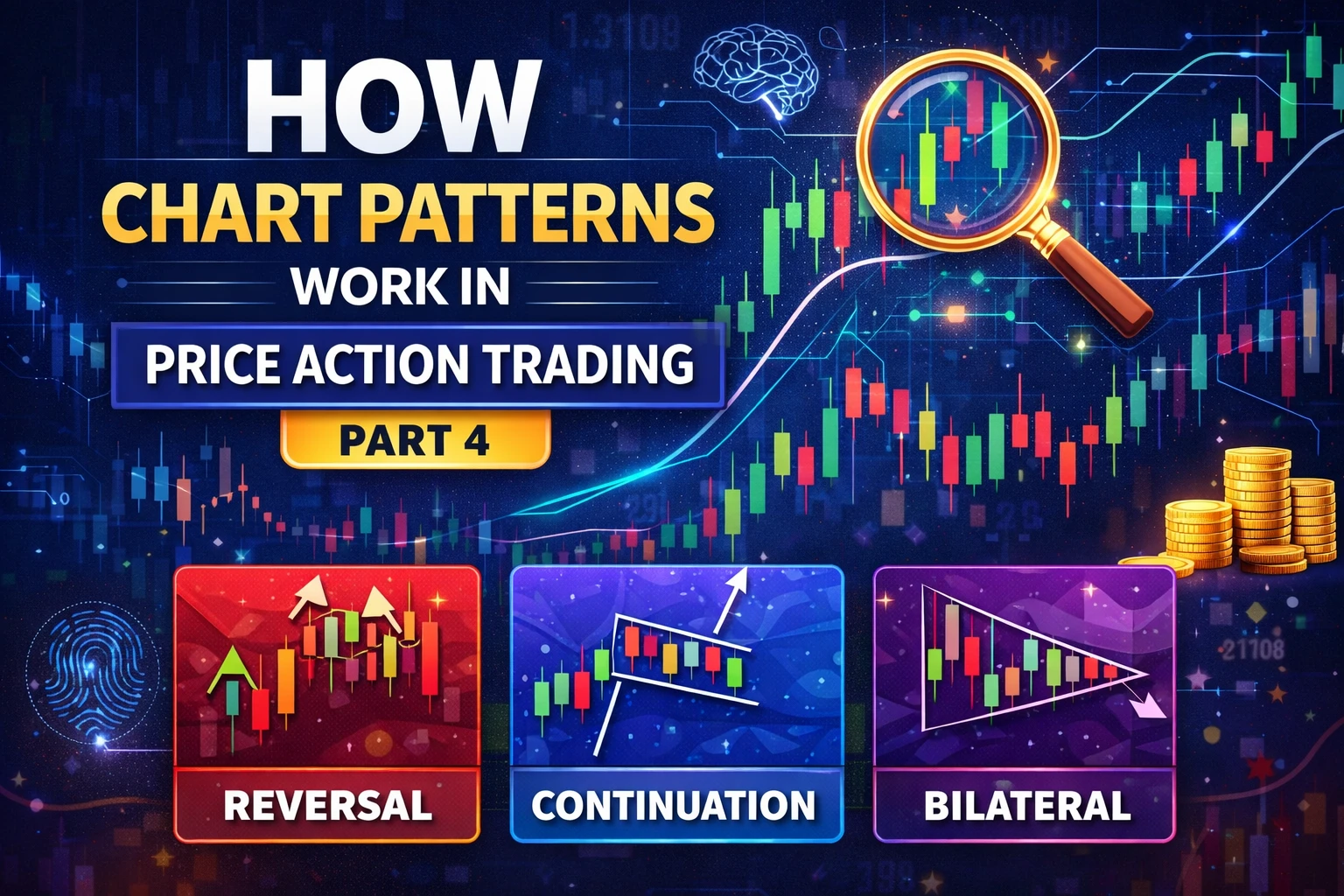
These patterns are commonly grouped into three major categories:
- Reversal patterns
- Continuation patterns
- Bilateral patterns
Each of these patterns reflects different types of market behavior.
For example:
- Reversal patterns may indicate that an existing trend could change direction.
- Continuation patterns often appear when a trend temporarily pauses before continuing.
- Bilateral patterns represent situations where the market could break in either direction.
However, simply memorizing chart patterns is not enough to fully understand how markets behave.
To become more comfortable with price action trading, traders must also understand why chart patterns form and what they reveal about market structure, volatility, and trader psychology.
In this chapter, we will explore the underlying mechanics behind chart patterns and how they function in real market environments.
The Role of Consolidation in Price Action
One of the most important concepts behind chart patterns is market consolidation.
Financial markets do not move in a perfectly straight line. Instead, price movements often occur in repeating cycles that include both trending and consolidating phases.
A typical market cycle often includes two major phases:
- Expansion
- Consolidation
Expansion Phase
During expansion, price moves strongly in one direction. This phase is usually driven by a clear imbalance between buyers and sellers.
Examples include:
- Strong bullish trends where buyers dominate the market
- Strong bearish trends where selling pressure increases
Expansion phases often produce large candlesticks, higher momentum, and increased volatility.
Consolidation Phase
After a strong move, markets often enter a period of consolidation.
During consolidation:
- Price moves within a defined range
- Momentum slows down
- Traders reassess their positions
- Liquidity begins to build around important price levels
Many chart patterns form during these consolidation phases.
Examples include:
- Rectangles
- Flags
- Pennants
- Triangles
From a market structure perspective, consolidation represents a temporary pause where the market gathers liquidity before making the next directional move.
How Volatility Behaves Around Chart Patterns
Another key factor behind chart pattern formation is volatility behavior.
Volatility refers to how much price fluctuates over time.
Understanding how volatility changes during different market phases can help traders better interpret chart patterns.
Volatility Contraction
When many chart patterns begin forming, volatility often starts to decrease.
This happens because the market temporarily enters a phase where buyers and sellers are relatively balanced.
Typical signs of volatility contraction include:
- Smaller candlestick bodies
- Narrower price ranges
- Slower price movement
- Reduced momentum
This contraction phase often occurs during consolidation patterns such as triangles or rectangles.
Volatility Expansion
Eventually, the market may break out of the consolidation structure.
When this occurs, volatility often expands again, meaning price begins to move more aggressively.
Volatility expansion can occur when:
- New traders enter the market
- Liquidity zones are triggered
- Economic events influence market sentiment
This contraction–expansion cycle is a common characteristic of financial markets and plays an important role in the development of many chart patterns.
Continuation vs Reversal Patterns
One challenge beginner traders often face is distinguishing between continuation patterns and reversal patterns.
Although chart patterns can appear visually similar, their meaning can change depending on the broader market context.
Reversal Patterns
Reversal patterns appear when a trend may be losing momentum and the market could potentially change direction.
Common reversal patterns include:
- Head and Shoulders
- Double Top
- Double Bottom
- Rounding Bottom
These patterns often appear after extended trending movements where market participants begin taking profits or adjusting positions.
Continuation Patterns
Continuation patterns typically appear when the market pauses temporarily during a strong trend.
Examples include:
- Flags
- Pennants
- Rectangles
- Wedges
Instead of reversing direction, the market often consolidates briefly before continuing the existing trend.
Bilateral Patterns
Some chart patterns are considered bilateral, meaning price could break out in either direction.
Triangles are a common example of bilateral patterns.
In these situations, traders often focus more on breakout confirmation rather than predicting direction in advance.
Understanding these differences helps traders interpret patterns more realistically rather than relying purely on pattern shapes.
Common Mistakes Traders Make With Chart Patterns
Although chart patterns are widely used in technical analysis, many beginner traders misunderstand how they should be interpreted.
Here are several common mistakes traders often make.
Trying to Memorize Patterns Without Understanding Context
Many beginners attempt to memorize chart patterns as if they were simple formulas.
However, patterns should always be analyzed within the broader market context.
Factors such as trend strength, support and resistance levels, and liquidity zones all influence how patterns behave.
Trading Patterns Too Early
Another common mistake is attempting to trade while a pattern is still forming.
During the early stages of pattern development, price movements can be unpredictable.
Experienced traders often wait for clearer market structure before interpreting chart patterns.
Ignoring the Larger Market Trend
Chart patterns should ideally be analyzed alongside the overall market trend.
For example:
- A continuation pattern may behave differently in a strong trend compared to a ranging market.
Understanding the higher-timeframe trend helps traders interpret patterns more effectively.
Poor Risk Management
Even when chart patterns appear clear, outcomes remain uncertain.
Financial markets are influenced by numerous factors including:
- Macroeconomic events
- Central bank decisions
- Market sentiment
- Liquidity conditions
For this reason, responsible traders often manage risk carefully by considering:
- Position sizing
- Stop-loss placement
- Probability-based decision making
If you want to understand these concepts in more detail, you can read our complete guide on forex risk management for beginners:Forex Risk Management for Beginners: Capital Allocation, Risk Reward Ratio, and Realistic Trading Goals.
Developing strong risk management habits is essential because long-term trading success depends not only on analysis but also on capital preservation and disciplined decision making.
Practice Exercise for Beginners
One of the most effective ways to understand chart patterns is through chart observation and practice.
To improve your ability to recognize patterns, try the following exercise.
Open your charting platform and review historical charts on instruments such as:
- EUR/USD
- GBP/USD
- Gold (XAU/USD)
- Major stock indices
Look for examples of:
- Reversal patterns
- Continuation patterns
- Bilateral patterns
While studying charts, ask yourself questions such as:
- What trend existed before the pattern formed?
- Did volatility decrease during consolidation?
- What happened after the pattern completed?
Regular chart observation helps traders build a stronger understanding of market structure and price behavior.
If you have any questions while practicing, you can ask them in the comment section, and we will try to respond.
Conclusion
Chart patterns are an important component of price action analysis because they help traders interpret how markets behave during different phases of price movement.
However, successful trading requires more than recognizing visual patterns on a chart.
Traders must also understand the underlying dynamics behind those patterns, including:
- Market consolidation
- Volatility behavior
- Liquidity dynamics
- Trader psychology
By combining pattern recognition with a deeper understanding of market behavior, traders can develop a more balanced and realistic approach to price action trading.
This article is provided for educational purposes only and should not be considered financial advice.
Frequently Asked Questions
What are chart patterns in price action trading?
Chart patterns are recognizable structures formed by price movements that help traders interpret market behavior and potential future price movement.
Why do chart patterns form?
Chart patterns often form because of the interaction between buyers and sellers during consolidation phases, liquidity accumulation, and changes in market sentiment.
Are chart patterns reliable?
Chart patterns can provide useful insights, but they should always be analyzed alongside market context, volatility, and proper risk management.
How can beginners learn chart patterns effectively?
Studying historical charts and observing how patterns develop in real market conditions is one of the most effective learning methods.

Written by
Trade Together Research
Trade Together Research is a professional market analysis team providing forex, gold, and crypto trading insights, technical analysis, and educational guides.. Learn more about our research team on the About page.