How Forex Trading Works Inside Your Account: Lots, Leverage, Margin & Real Risk Explained - Chapter 2
Fri Feb 27 2026
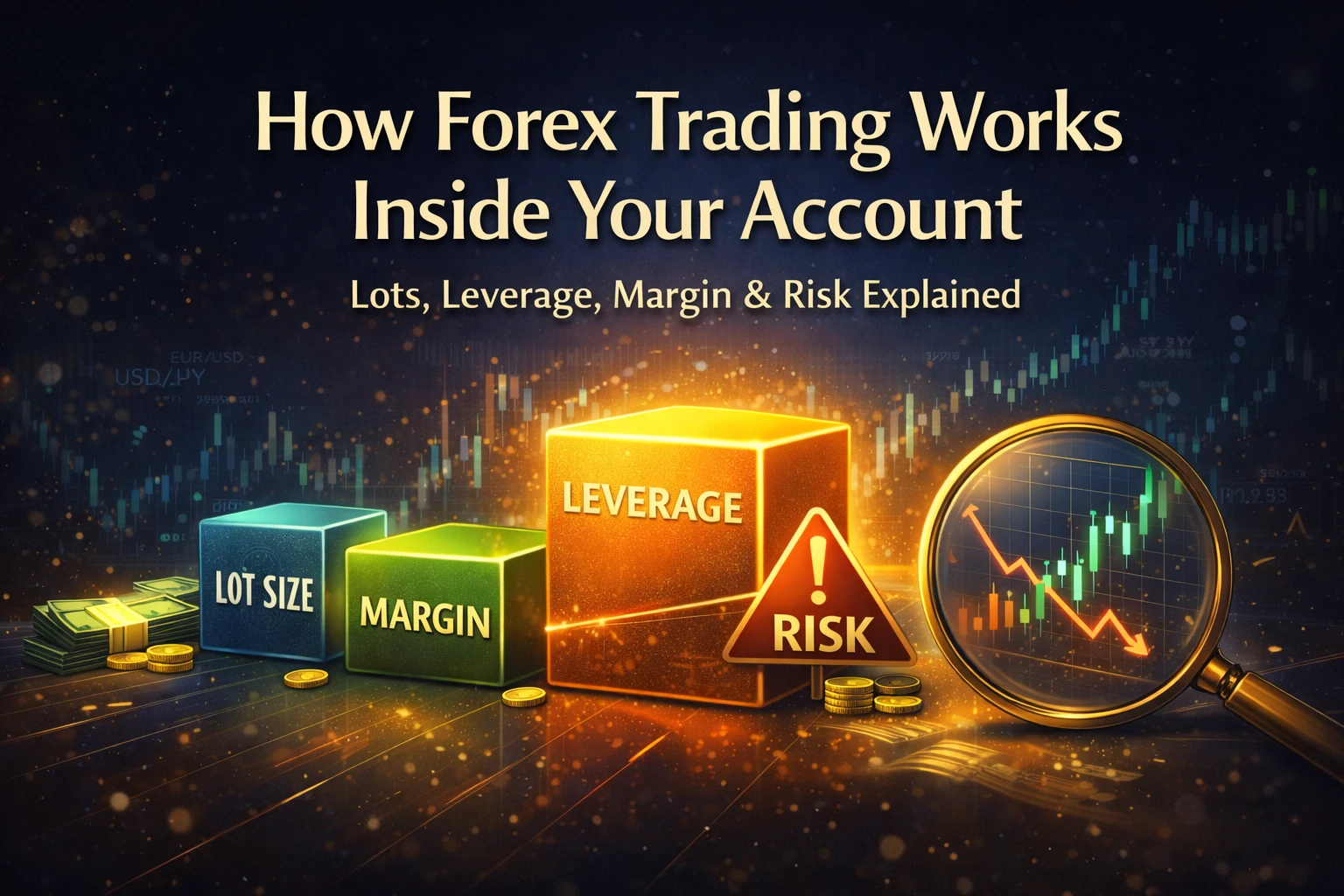
Many beginners learn what Forex is but do not fully understand how trading mechanically works inside their account.
Most trading failures do not happen because of poor strategy. They happen because traders misunderstand:
- Order execution
- Position sizing
- Leverage exposure
- Margin mechanics
- Trading costs
This chapter explains Forex trading mechanics in a structured, professional, and beginner-friendly way. The goal is to build long-term understanding, not short-term excitement.
If you have not yet read the foundation, start with What Is Forex and How Currency Pairs Work ( https://tradetogether.in/articles/forex-course-for-beginners-chapter-1-what-is-forex-and-how-currency-pairs-work ) – Chapter 1 before continuing.
1. How Forex Orders Are Executed in Real Market Conditions
What Is an Order?
An order is an instruction you send to your broker to buy or sell a currency pair under specific conditions.
The Forex market is decentralized. There is no central exchange. Your broker connects your order to liquidity providers such as banks, institutions, and electronic networks.
Orders allow you to participate in global currency price movements.
Types of Orders
1. Market Order
Executes immediately at the best available price.
2. Limit Order
Executes only at a specific better price.
3. Stop Order
Activates once price reaches a trigger level.
4. Stop-Loss Order
Closes a trade automatically to limit loss.
5. Take-Profit Order
Closes a trade automatically to lock profit.
What Is Slippage?
Slippage is the difference between the price you expect and the actual execution price.
Example:
You click Buy at 1.1000. Your order fills at 1.1003.
The 3-pip difference is slippage.
Slippage happens due to:
- Rapid market movement
- Thin liquidity
- Large orders
- News events
Why Execution Quality Matters
Forex prices move because of:
- Global liquidity flows
- Institutional trading activity
- Economic data releases
- Market volatility
During major economic releases, spreads widen and slippage increases.
What Traders Should Learn
- Execution price is not always identical to the quoted price
- Fast markets increase slippage risk
- Stop orders can trigger at different prices than expected
- Liquidity conditions change throughout the day
2. Lot Size and Position Sizing: The Foundation of Risk Management
What Is a Lot?
A lot is the standardized unit used to measure trade size in Forex.
Because currencies trade in large amounts, lot sizes create consistency.
Why Lot Size Matters
Lot size determines how much each pip movement is worth.
Example (EUR/USD):
If price moves 30 pips:
- 0.01 lot → small financial impact
- 0.10 lot → moderate financial impact
- 1.00 lot → large financial impact
Same market idea. Completely different financial impact.
What Is Position Sizing?
Position sizing is the process of calculating lot size based on how much you are willing to risk.
Professional traders:
- Define risk before entering a trade
- Use stop-loss distance to calculate lot size
- Keep risk consistent across trades
Example:
Account = $5,000 Risk per trade = 1% = $50 Stop-loss = 25 pips
$50 ÷ 25 = $2 per pip Position ≈ 0.20 lot
Position sizing protects long-term survival.
This transition from emotional trading to structured risk control is discussed in ( https://tradetogether.in/articles/5-stages-of-a-profitable-forex-trader ) The 5 Stages of Becoming a Profitable Forex Trader.
3. Leverage, Margin and Margin Level: Understanding Exposure
What Is Leverage?
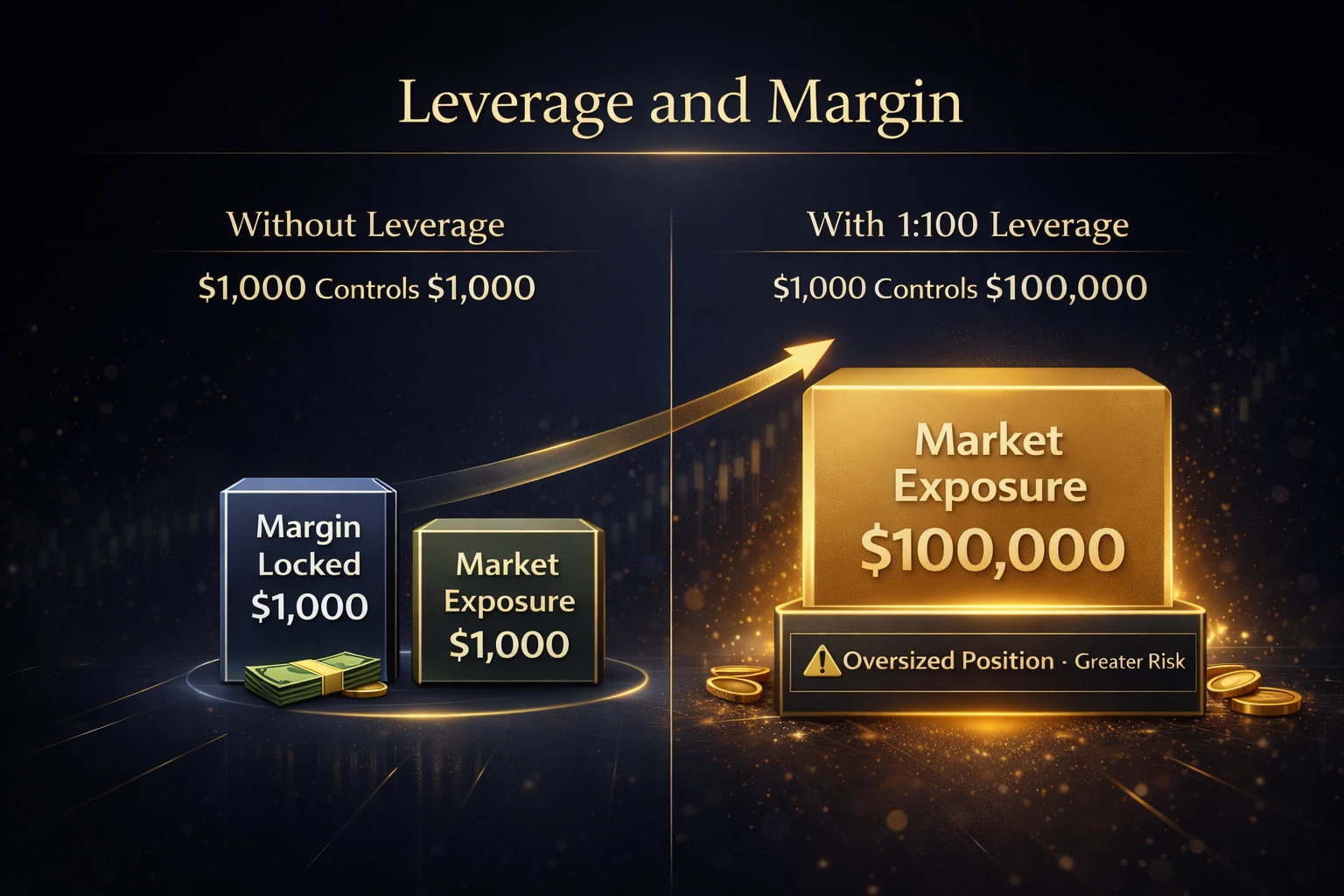
Leverage allows you to control a large position using a smaller amount of capital.
If leverage is 1:100:
Every $1 controls $100 in the market.
Example:
With $1,000 and 1:100 leverage, You can control $100,000.
Leverage increases both profit potential and loss potential. Leverage itself is neutral. Misuse creates risk.
What Is Margin?
Margin is the capital your broker sets aside as collateral to keep your trade open.
Margin is not a fee. It is locked while the trade remains active.
Formula:
Margin = Position Size ÷ Leverage
Example:
$100,000 position with 1:100 leverage Margin required = $1,000
What Is Margin Level?
Margin level measures account safety.
Margin Level = (Equity ÷ Used Margin) × 100
Where:
- Equity = Account balance + floating profit/loss
- Used Margin = Margin currently locked for open trades
Example:
Equity = $2,000 Used Margin = $1,000
Margin Level = 200%
Higher margin level = safer account.
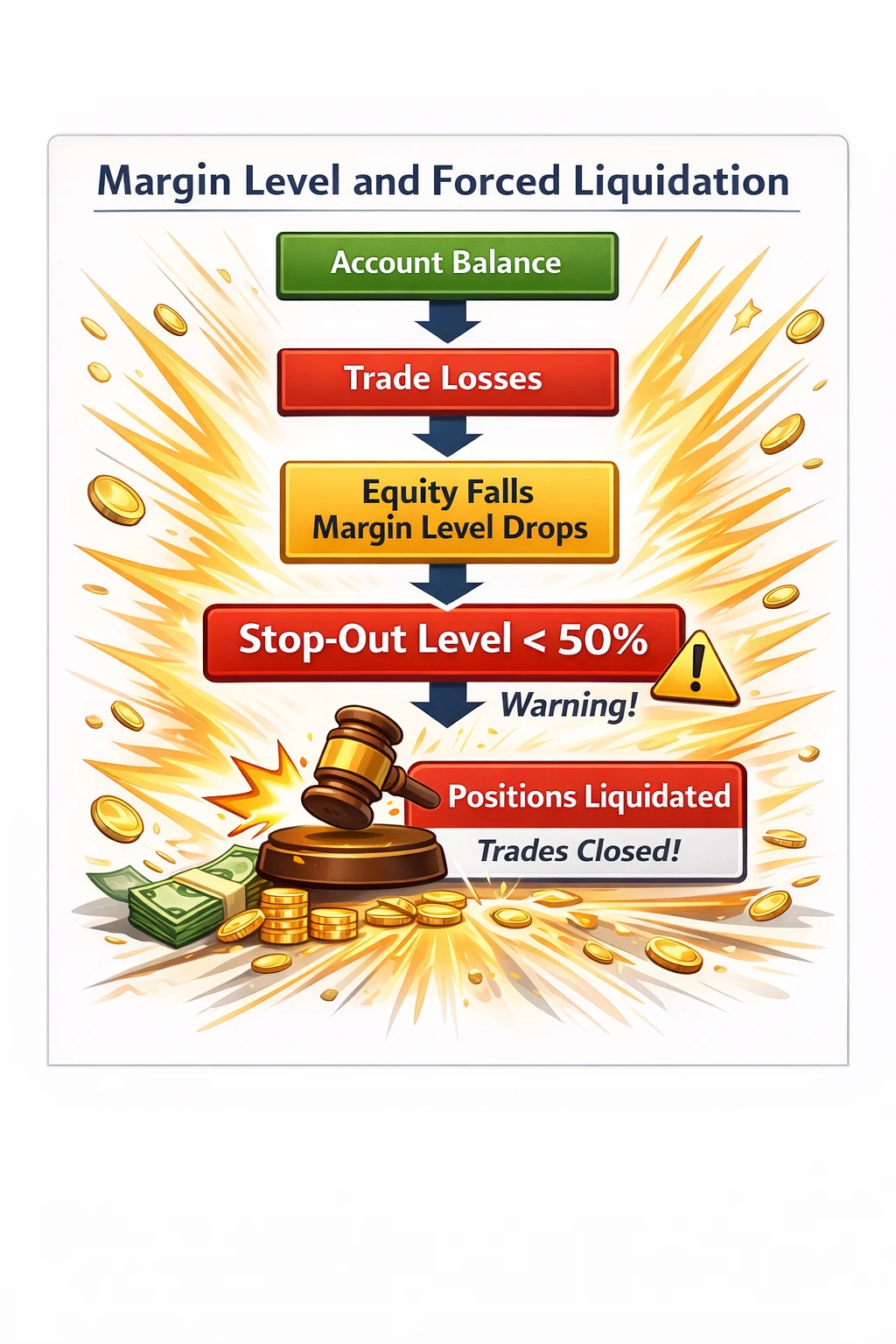
What Is Forced Liquidation (Stop-Out)?
Forced liquidation happens when your margin level drops below your broker’s stop-out threshold.
Many brokers set stop-out levels between 20%–50%.
If margin level falls below that:
- The broker begins closing your open trades
- Positions are closed automatically
- Trades with the largest losses are usually closed first
Why Forced Liquidation Happens
It usually occurs when:
- Excessive leverage is used
- Multiple large trades are opened
- No proper stop-loss is used
- Large market volatility occurs
This often happens during:
- Major economic news releases
- Sudden market volatility
- Low liquidity conditions
What Traders Should Learn
- Leverage must be used carefully
- Margin level reflects account safety
- Large position sizes increase liquidation risk
- Proper risk management prevents stop-outs
4. Pip, Spread and Total Trading Costs
What Is a Pip?
A pip (Percentage in Point) is the standard unit used to measure price movement in Forex.
It represents the smallest commonly quoted price change.
For most currency pairs:
1 pip = 0.0001
Example:
EUR/USD moves from 1.1000 to 1.1005 That is 5 pips.
For JPY pairs:
1 pip = 0.01
Example:
USD/JPY moves from 150.00 to 150.10 That is 10 pips.
Pips help measure:
- Price movement
- Profit and loss
- Stop-loss distance
- Trading costs
What Is Spread?
Spread is the difference between the Bid and Ask price.
Example:
Bid: 1.1000 Ask: 1.1002 Spread = 2 pips
Spread is a trading cost.
You begin every trade slightly negative because of this cost.
Spreads widen during:
- High volatility
- Major economic announcements
- Low liquidity periods
What Is Trading Cost?
Total trading cost may include:
- Spread
- Commission (if charged by the broker)
- Slippage
- Swap or overnight financing
Frequent trading increases overall cost exposure. Reducing unnecessary trades improves capital efficiency.
5. Profit, Loss and Swap (Overnight Financing)
How Profit and Loss Are Calculated
Profit or loss is calculated using:
Pip Movement × Pip Value
Example:
Buy at 1.1000 Sell at 1.1050 Movement = 50 pips
If trading 0.50 lot ($5 per pip):
50 × $5 = $250
Actual net result may vary slightly due to costs.
What Is Swap (Overnight Financing)?
Swap is the interest adjustment applied when you hold a trade overnight.
In Forex, you are effectively borrowing one currency to buy another.
Each currency has an interest rate determined by its central bank.
If you hold a position overnight:
- You may receive interest
- You may pay interest
This depends on:
- The interest rate of the base currency
- The interest rate of the quote currency
- Whether the position is buy or sell
Example:
If you buy a currency with a higher interest rate against a lower-rate currency, You may receive positive swap.
If opposite, You may pay swap.
Swap can significantly affect swing or long-term trades.
6. Psychological Leverage and Trading Stability
What Is Psychological Leverage?
Psychological leverage refers to the emotional pressure created by trading oversized positions relative to your comfort level.
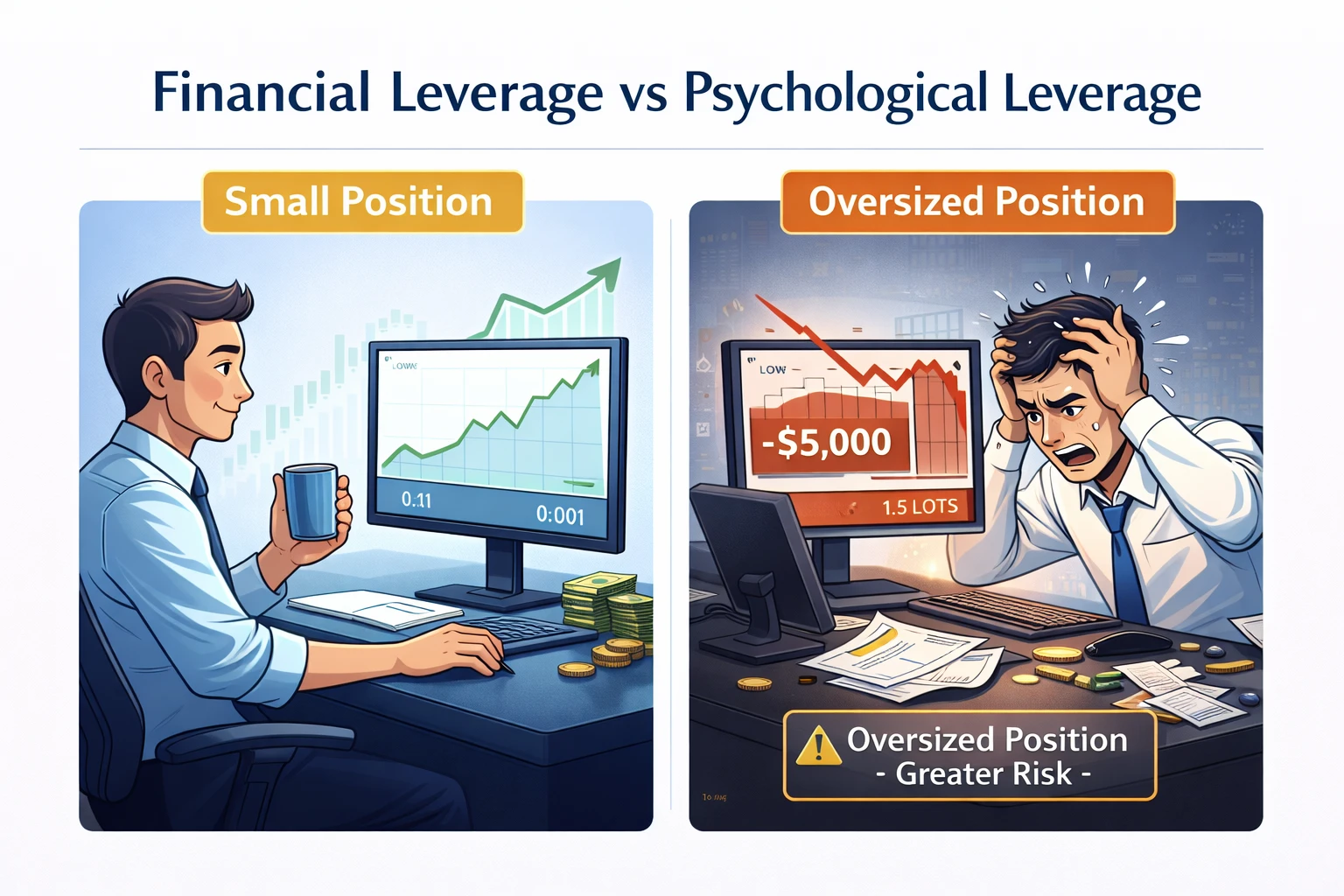
Even if financially affordable, large position sizes can:
- Increase emotional stress
- Trigger impulsive decisions
- Cause premature trade exits
- Lead to revenge trading
Why It Happens
Human decision-making deteriorates under financial stress.
Large floating losses activate fear responses.
This leads to:
- Panic closing trades
- Moving stop-loss emotionally
- Overtrading to recover losses
What Traders Should Learn
- Position size should match emotional tolerance
- Lower leverage improves trading stability
- Risk management protects psychological discipline
- Professional trading is about probability management, not prediction certainty.
Professional trading is about probability management, not prediction certainty.
Frequently Asked Questions
1. Is high leverage always dangerous?
Leverage increases exposure. Risk depends on position sizing and stop-loss placement.
2. What is a safe risk percentage per trade?
Many disciplined traders risk 1–2% per trade to preserve capital during losing streaks.
3. Why does my trade start negative?
Because of spread. You buy at Ask and sell at Bid.
4. How quickly can forced liquidation happen?
It can happen rapidly during volatile macro events if trades are oversized.
5. Does increasing lot size increase win rate?
No. It increases exposure, not probability.
Conclusion
Forex trading mechanics form the foundation of professional trading.
Every trader must understand:
- How order execution works in real market conditions
- How lot size determines financial exposure
- How leverage magnifies both profit and loss
- How margin protects the broker and controls exposure
- How spreads and costs affect every trade
Most trading failures result from poor risk management, not poor analysis.
Master mechanics before focusing on advanced strategies.

Written by
Trade Together Research
Trade Together Research is a professional market analysis team providing forex, gold, and crypto trading insights, technical analysis, and educational guides.. Learn more about our research team on the About page.