How Banks and Institutions Trade Forex: Capital Allocation, Regulation and Retail Lessons Explained (Advanced Guide) - Chapter 7
Wed Mar 04 2026

In Chapter 6, we discussed different trading styles — scalping, intraday, swing, and position trading — and how each requires a different risk framework. Earlier, in Chapter 4, we examined how the decentralized OTC forex market operates, and in Chapter 5, we explored how brokers and funded firms make money within that structure.
Now we move to an advanced topic:
How do banks and institutions actually trade forex — and what can retail traders realistically learn from them?
This chapter is advanced. It focuses on institutional capital allocation, regulatory constraints, macro positioning logic, and practical retail takeaways.
Understanding Institutional Forex Trading
What It Is
Institutional forex trading refers to currency transactions conducted by:
- Commercial banks
- Investment banks
- Central banks
- Hedge funds
- Asset managers
- Multinational corporations
Unlike retail traders, institutions operate under balance sheet constraints, capital requirements, and regulatory oversight.
Why It Exists
Currencies are necessary for:
- International trade settlement
- Portfolio diversification
- Capital reallocation between economies
- Hedging foreign exposure
Many institutional transactions are not short-term speculation. They are often:
- Hedging transactions
- Liquidity management
- Macro-based capital allocation
What Retail Traders Should Learn
Institutions do not approach the market emotionally. Their structure forces discipline. Retail traders must build similar discipline voluntarily.
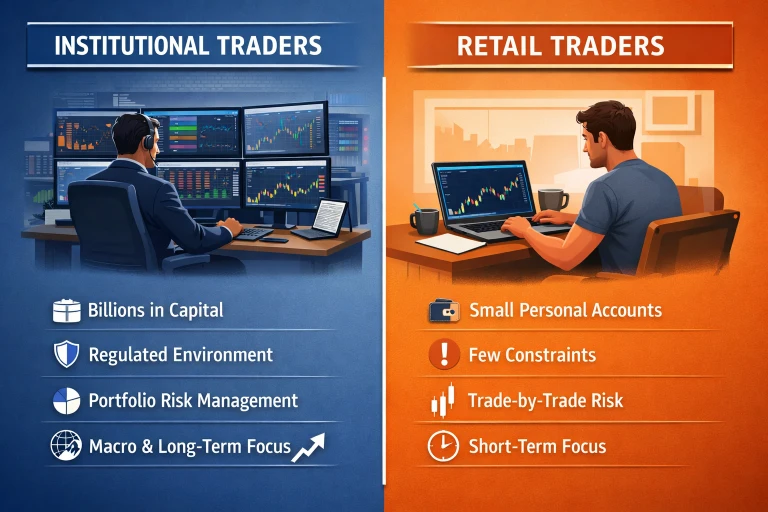
Why Banks Prefer Longer-Term Positioning
What Happens
Banks typically position around:
- Interest rate cycles
- Inflation trends
- Central bank policy divergence
- Economic growth differentials
They rarely scalp in the retail sense.
Why It Happens
Large institutions manage:
- Billions in capital
- Regulatory capital buffers (Basel III frameworks)
- Liquidity coverage ratios
- Risk-weighted assets
Frequent short-term trading:
- Increases transaction costs
- Impacts liquidity
- Reduces balance sheet efficiency
Institutions optimize capital deployment, not trade frequency.
What Traders Should Learn
Retail traders often overtrade because they lack structural constraints. Institutions show that:
Capital preservation and patience outweigh trade frequency.
This aligns more closely with swing and position trading styles discussed in Chapter 6 🔗https://tradetogether.in/articles/forex-trading-styles-explained-scalping-intraday-swing-position .
The Role of Regulation in Institutional Forex Trading
What It Is
Banks operate under regulatory standards requiring:
- Capital adequacy
- Stress testing
- Risk exposure limits
- Liquidity buffers
These frameworks limit excessive speculative exposure.
Why It Matters
If a bank increases speculative risk:
- It increases required capital reserves
- It reduces return on capital efficiency
- It may trigger regulatory scrutiny
Risk must remain proportional to balance sheet strength.
What Retail Traders Should Learn
Retail traders may use high leverage because it is accessible. But survival depends on self-imposed discipline.
Example:
Risking 5–10% per trade may lead to severe drawdowns. Institutions rarely take concentrated risk in this way.
A sustainable approach might involve risking 0.5–1% per trade, depending on volatility and stop-loss distance.
Liquidity, Capital Flows and Macro Positioning
What Happens in Currency Markets
Currency movements are often driven by:
- Changes in interest rate expectations
- Shifts in inflation outlook
- Risk sentiment changes
- Cross-border capital flows
When institutions reallocate capital gradually, sustained trends can develop.
Why It Happens
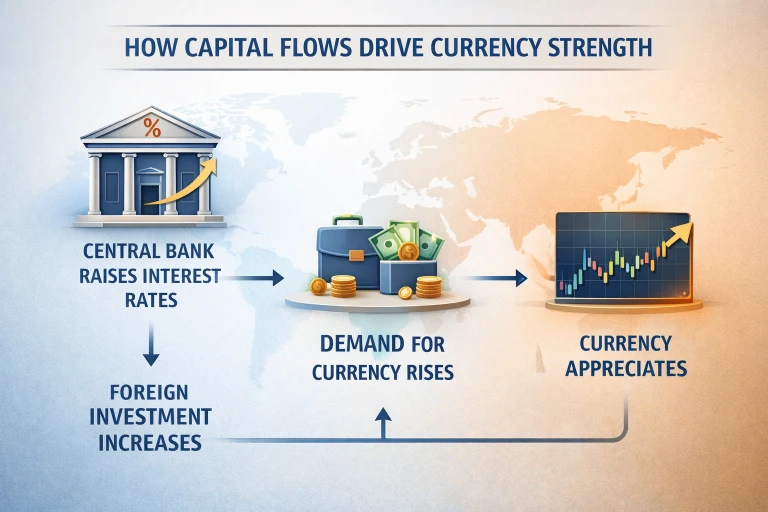
If a country raises interest rates:
- Capital may flow into that currency
- Demand increases
- Trend structure may form
This is macro positioning — not random price movement.
What Retail Traders Should Learn
Understanding macro context improves probability.
Instead of trading every minor fluctuation, traders can:
- Align with broader economic trends
- Avoid thin liquidity periods
- Be cautious around major central bank events
This connects back to market structure discussed in Chapter 4 🔗https://tradetogether.in/articles/centralized-vs-decentralized-forex-market-structure .
Institutional Risk Management vs Retail Risk Management
Institutional Framework
Institutions evaluate risk through:
- Portfolio-level exposure
- Asset correlation
- Stress testing scenarios
- Value-at-Risk (VaR) models
- Maximum drawdown limits
Risk is measured across the entire portfolio, not individual trades.
Retail Framework
Retail traders should think in terms of:
- Percentage risk per trade
- Position sizing relative to stop-loss
- Maximum weekly or monthly drawdown
- Volatility-adjusted exposure
Example:
If risking 1% per trade with a 120-pip stop-loss, position size must be adjusted to maintain consistent exposure.
Probability thinking is more important than prediction.
Core Lesson
Institutions prioritize risk management before return optimization. Retail traders should adopt the same hierarchy.
Common Misconceptions About “Smart Money”
Many retail traders believe:
- Banks deliberately hunt stop-losses
- Institutions constantly trade against retail
- Market movement is always manipulation
While liquidity clusters can attract price movement, forex is decentralized and highly liquid. Price is driven by order flow, capital flows, and macro shifts — not personal targeting.
Emotional narratives often distort rational analysis.
Practical Retail Takeaways from Institutional Behavior
- Reduce unnecessary leverage.
- Avoid overtrading.
- Focus on macro context.
- Size positions conservatively.
- Accept that uncertainty is inherent.
Institutions survive because they manage risk structurally.
Retail traders must do the same voluntarily.
Frequently Asked Questions
Do banks manipulate the forex market?
Banks influence liquidity due to size, but forex is decentralized and competitive. Macro factors and capital flows are primary drivers.
Why don’t banks scalp like retail traders?
Large order size, capital regulation, and cost efficiency make high-frequency retail-style scalping impractical for institutions.
Can retail traders copy institutional strategies?
Retail traders cannot replicate balance sheet scale, but they can adopt institutional discipline and macro awareness.
Is institutional trading safer?
No trading is inherently safe. Risk depends on leverage, exposure, and capital management.
Conclusion
Institutional forex trading is shaped by capital allocation, regulatory constraints, liquidity dynamics, and macroeconomic cycles. Banks prioritize balance sheet efficiency and long-term stability over short-term excitement.
Retail traders cannot operate like institutions in size — but they can adopt institutional principles:
- Disciplined risk management
- Probability-based thinking
- Conservative leverage
- Capital preservation mindset
This article is for educational purposes only and does not constitute financial advice. All trading involves risk, and outcomes are never guaranteed.

Written by
Trade Together Research
Trade Together Research is a professional market analysis team providing forex, gold, and crypto trading insights, technical analysis, and educational guides.. Learn more about our research team on the About page.