How to Choose the Right Forex Trading Style for Your Personality and Risk Profile (Scalping vs Intraday vs Swing vs Position) – Chapter 6
Mon Mar 02 2026

In Chapter 4, we explained how the decentralized OTC forex market operates and how liquidity shifts across trading sessions. In Chapter 5, we discussed how brokers and funded firms function within that structure. Now the practical question becomes:
Which forex trading style should you choose — and why?
Forex trading is not a single method. It operates across multiple time horizons, volatility regimes, and capital allocation structures. Choosing a trading style that does not align with your personality, available time, or risk tolerance often leads to inconsistency.
This chapter explains the four primary forex trading styles — scalping, intraday, swing, and position trading — including their advantages, disadvantages, institutional relevance, capital allocation logic, and risk management differences.
What Are the Main Types of Forex Trading?
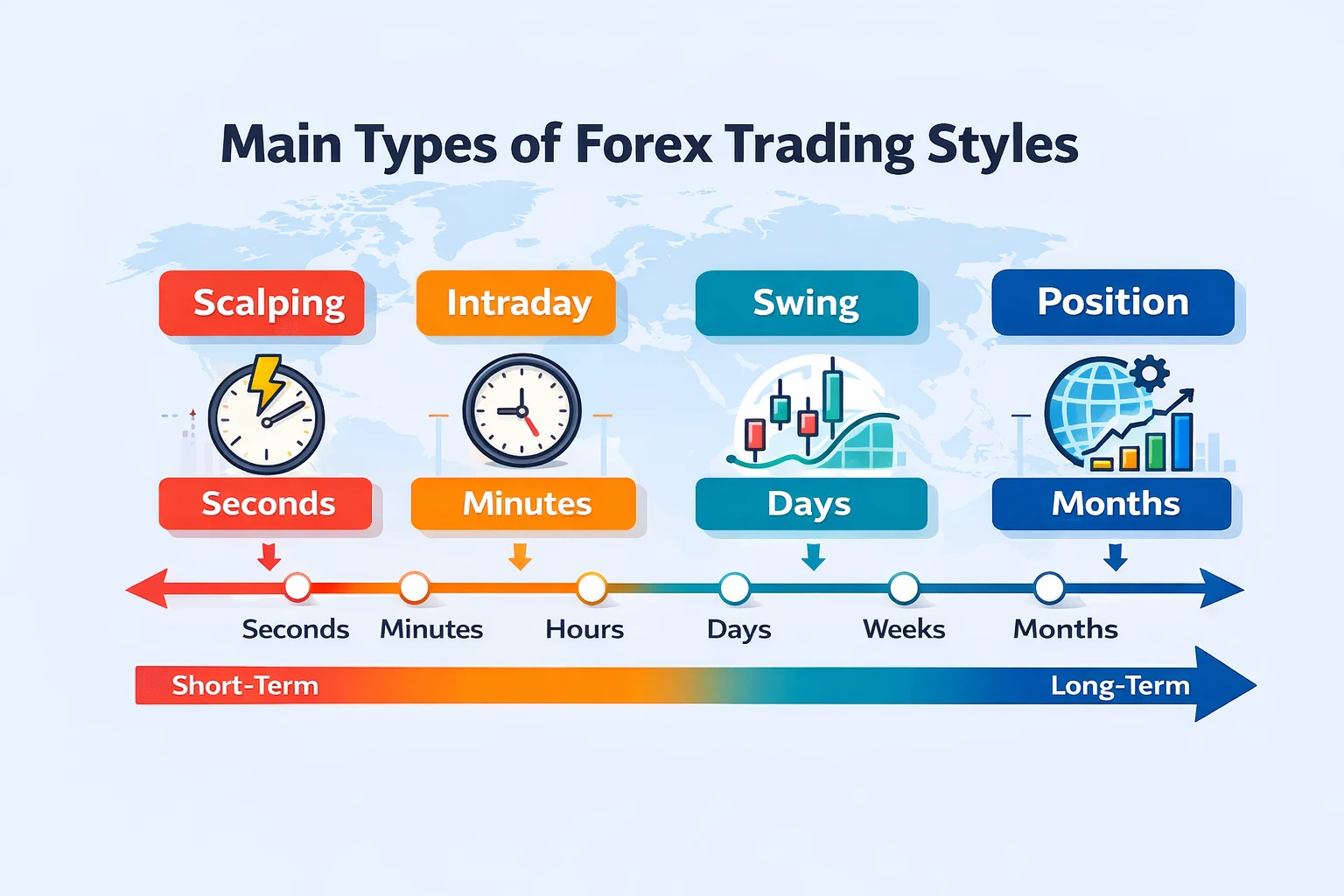
Forex trading styles are categorized based on holding period and market exposure duration:
- Scalping – Seconds to minutes
- Intraday (Day Trading) – Minutes to hours (closed the same day)
- Swing Trading – Days to weeks
- Position Trading – Weeks to months
Each style interacts differently with:
- Time availability
- • Market volatility
- • Liquidity conditions
- • Trading psychology
- • Risk management structure
If you are still unclear about leverage, lot sizing, or account structure before choosing a style, revisit How to Start Forex Trading Safely for Beginners - Chapter 3 ( https://tradetogether.in/articles/start-forex-trading-safely-beginners-demo-real-funded ) to understand capital exposure fundamentals.
There is no universally superior style. There is only structural alignment.
Scalping: Short-Term Liquidity Exploitation
What It Is
Scalping focuses on capturing very small price movements during high-liquidity periods such as the London and New York session overlap.
Holding period: Seconds to minutes.
Why It Exists
In a decentralized OTC market (as explained in Is Forex Centralized or Decentralized? – Chapter 4 🔗https://tradetogether.in/articles/centralized-vs-decentralized-forex-market-structure ), price fluctuations occur continuously due to:
- Liquidity changes
- • Order flow imbalance
- • High-frequency execution
High liquidity allows rapid execution and frequent opportunity.
Advantages
- Many trading opportunities
- • Limited overnight risk
- • Smaller market exposure duration
- • Immediate feedback on trade ideas
Disadvantages
- High transaction costs (spreads & commissions)
- • Emotionally intense decision making
- • Requires constant screen monitoring
- • Slippage can quickly affect performance
Risk Framework
Scalpers typically use tight stop-losses (5–15 pips). Because stops are small, position sizing must be precise.
Example: If risking 0.5% per trade with a 5-pip stop, even minor slippage can distort risk-reward balance.
Probability structure often involves:
- High win rate
- • Smaller reward per trade
- • Large number of trades
Discipline is critical to prevent overtrading.
Intraday Trading: Session-Based Volatility Strategy
What It Is
Intraday traders open and close trades within the same trading session, avoiding overnight exposure.
Holding period: Minutes to hours.
Why It Exists
Volatility clusters around:
- London session open
- • New York session open
- • Major economic data releases
Intraday traders attempt to capture structured volatility expansions.
Advantages
- No overnight risk
- • More time for analysis compared to scalping
- • Lower psychological pressure than ultra-fast trading
Disadvantages
- Requires daily market monitoring
- • News events can cause sudden volatility spikes
- • Emotional fatigue from frequent decision making
Risk Framework
Daily loss limits are essential. Example: If maximum daily risk is 2% and each trade risks 1%, two losses require stopping for the day. Typical reward-to-risk ratios range between 1:1 and 1:2 depending on volatility regime.
Swing Trading: Capturing Market Structure Waves
What It Is
Swing trading focuses on medium-term price movements driven by broader macroeconomic and structural trends.
Holding period: Several days to weeks.
Why It Exists
Currencies respond to:
- Macroeconomic data
- • Interest rate expectations
- • Institutional positioning
Swing traders align with broader structural shifts rather than short-term noise.
Understanding broker execution structure and liquidity conditions (discussed in How Forex Brokers and Funded Firms Make Money – Chapter 5 🔗 https://tradetogether.in/articles/a-book-vs-b-book-and-funded-firm-business-model ) becomes increasingly relevant at this level.
Advantages
- Fewer trades required
- • Less screen time
- • Potentially larger reward-to-risk ratios
Disadvantages
- Exposure to overnight news events
- • Requires patience during consolidations
- • Psychological difficulty holding positions for days
Risk Framework
Stop-loss distances may range from 80 to 200+ pips. Position size must decrease accordingly to maintain consistent percentage risk.
Example: If risking 1% per trade with a 150-pip stop, lot size must be reduced compared to scalping.
Swing trading may tolerate lower win rates but higher reward-to-risk ratios.
Position Trading: Long-Term Macro Alignment
What It Is
Position trading involves holding trades for extended periods aligned with macroeconomic cycles. Holding period: Weeks to months.
Why It Exists
Currency valuation is influenced by:
- Interest rate differentials
- • Monetary policy cycles
- • Economic growth divergence
- • Long-term capital flows
Institutions frequently operate within this time horizon.
Why Banks and Institutions Prefer Longer-Term Trading
Banks and institutional participants manage:
- Very large capital pools
- • Long-term portfolio allocations
- • Currency exposure for global investments
Short-term scalping is inefficient for institutions because:
- Execution size is large
- • Transaction costs accumulate quickly
- • Liquidity must be deep to enter and exit positions
Institutional trading is typically driven by macro positioning, capital preservation, and long-term capital flow analysis rather than micro volatility exploitation.
This reflects capital allocation structure — not superior intelligence.
Comparative Overview of Trading Styles
| Trading Style | Typical Holding Period | Screen Time Requirement | Typical Stop Loss |
|---|---|---|---|
| Scalping | Seconds – Minutes | Very High | 5–15 pips |
| Intraday | Minutes – Hours | High | 10–40 pips |
| Swing Trading | Days – Weeks | Moderate | 50–200 pips |
| Position Trading | Weeks – Months | Low | 200+ pips |
Risk Management Differences Across Styles
| Trading Style | Typical Stop Loss | Position Size | Risk Focus |
|---|---|---|---|
| Scalping | Very Tight | Small | Execution precision |
| Intraday | Tight | Moderate | Session volatility |
| Swing | Medium | Smaller | Trend continuation |
| Position | Wide | Small | Macro stability |
Key lesson:
Risk is not defined by holding time — it is defined by exposure size relative to capital.
Position sizing must adjust to volatility and stop-loss distance.
Psychological Suitability and Self-Assessment
Before choosing a style, evaluate:
- How much screen time you can realistically commit
- • Your tolerance for fast decision-making
- • Your patience for holding positions
- • Your emotional response to drawdowns
A style misaligned with personality often leads to inconsistency, even if the strategy itself is sound.
Frequently Asked Questions
Which trading style is safest?
No style is inherently safe. Risk depends on leverage control, stop-loss discipline, and capital allocation.
Do institutions scalp currencies?
Large institutions typically focus on macro positioning due to capital structure and regulatory considerations.
Is scalping more profitable?
Profitability depends on consistency and risk control — not speed of trading.
Can traders change styles over time?
Yes, but risk parameters must be recalibrated accordingly.
Conclusion
Scalping, intraday, swing, and position trading all operate within the same decentralized forex market but differ significantly in volatility exposure, liquidity interaction, capital allocation logic, and psychological demand.
There is no superior style — only alignment between trader structure and market conditions.
Long-term sustainability depends on disciplined position sizing, probability-based thinking, and capital preservation.
This article is for educational purposes only and does not constitute financial advice.

Written by
Trade Together Research
Trade Together Research is a professional market analysis team providing forex, gold, and crypto trading insights, technical analysis, and educational guides.. Learn more about our research team on the About page.