How Forex Brokers and Funded Firms Make Money: Execution Models and Evaluation Business Explained - Chapter 5
Sun Mar 01 2026
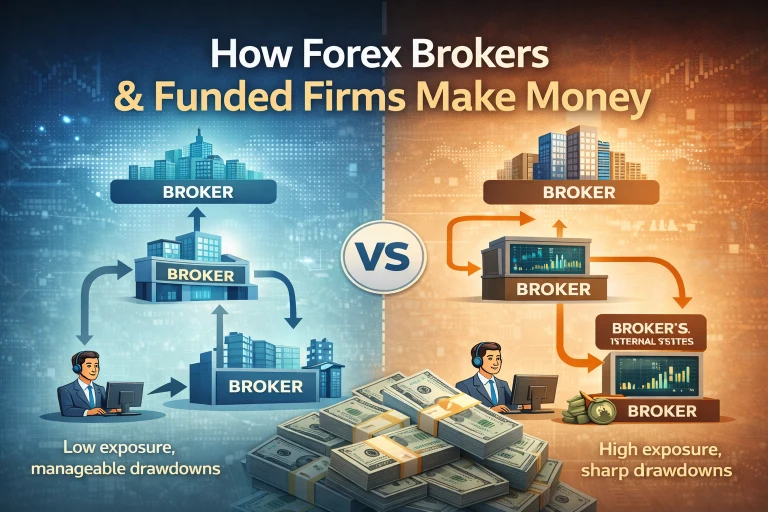
In the previous chapter, we studied how the forex market is structured as a decentralized OTC system and understood the difference between centralized and decentralized markets. If you have not read it yet, you can review Is Forex Centralized or Decentralized? OTC Market Structure Explained - Chapter 4 ( https://tradetogether.in/articles/centralized-vs-decentralized-forex-market-structure ) to understand how pricing and liquidity networks operate.
Now, in this chapter, we will examine how forex brokers and funded trading firms operate within that structure — and how they generate revenue.
Most traders focus on charts, indicators, and strategy. Very few take the time to understand how brokers and funded trading firms generate revenue.
This knowledge is not about distrust. It is about structural awareness.
Because forex operates as a decentralized OTC market, brokers and prop firms use different business models. Understanding these models helps traders evaluate transparency, regulation, and risk exposure before committing capital.
This chapter explains how forex brokers make money, how funded firms structure evaluation programs, and what traders should realistically understand.
1. How Retail Forex Brokers Make Money
What Most Traders Assume
Many beginners believe brokers only earn small commissions per trade.
In reality, broker revenue models are broader and vary depending on execution structure.
Primary Broker Revenue Sources
Retail brokers typically earn through:
- Bid–ask spreads
- Commissions on certain account types
- Financing charges (swap or overnight interest)
- Liquidity rebates or internalization efficiency
Some brokers operate pure agency models. Others use hybrid models.
What Traders Should Learn
A broker is a financial intermediary. Its goal is operational sustainability.
Revenue generation is normal. The key concern is transparency and regulation — not the existence of profit.
To better understand how spreads, margin, and leverage affect broker revenue mechanics, you may revisit How Forex Trading Works Inside Your Account: Lots, Leverage & Margin Explained -Chapter 2 (https://tradetogether.in/articles/forex-trading-mechanics-lots-leverage-margin-explained ).
2. A-Book vs B-Book Execution Models Explained
What Is the A-Book Model?
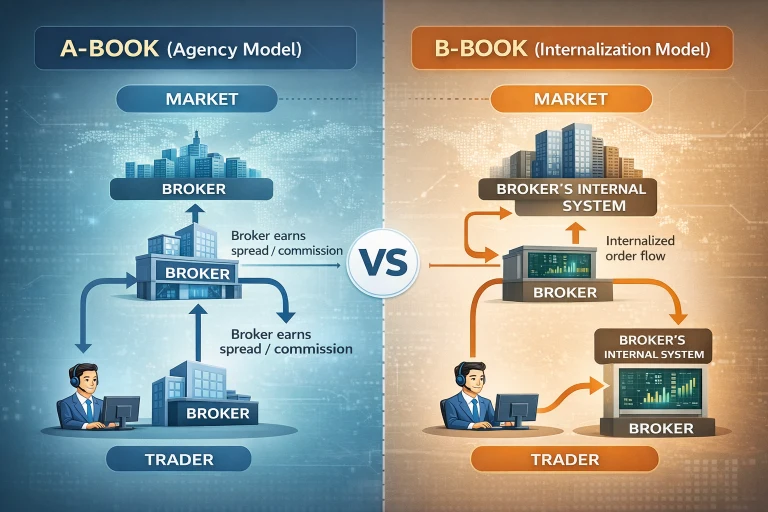
In an A-Book (agency) model:
- Trades are routed to external liquidity providers such as banks, prime brokers, or institutional liquidity pools.
This model reduces direct conflict of interest but depends heavily on liquidity relationships and infrastructure.
What Is the B-Book Model?
In a B-Book (internalization) model:
- Trades are handled internally rather than being routed to external liquidity providers.
- The broker effectively becomes the counterparty to the client's trade.
Statistically, many retail traders lose over time due to over-leverage, emotional decision-making, and poor risk management. In such cases, internalization can become profitable for the broker.
However, reputable brokers actively hedge risk when client exposure becomes concentrated.
Hybrid Models
Many brokers use hybrid systems:
- Some trades are routed externally to liquidity providers.
- Some trades are internalized depending on risk exposure and client behavior.
- Risk management algorithms determine which trades are hedged and which remain internal.
What Traders Should Learn
Internalization is not automatically unethical. It becomes problematic only when:
- Execution practices are opaque.
- Pricing or spreads are manipulated.
- Order handling lacks transparency.
- Clients cannot clearly verify how their orders are executed.
Always review execution policy documentation before choosing a broker.
3. How Funded (Prop) Firms Make Money
Funded trading firms typically operate on an evaluation-based model.
The Evaluation Fee Structure
Most funded programs follow this structure:
-
Trader pays an evaluation fee.
-
Trader must reach a profit target within strict drawdown limits.
-
Only a percentage of participants pass.
-
Failed evaluations contribute to firm revenue.
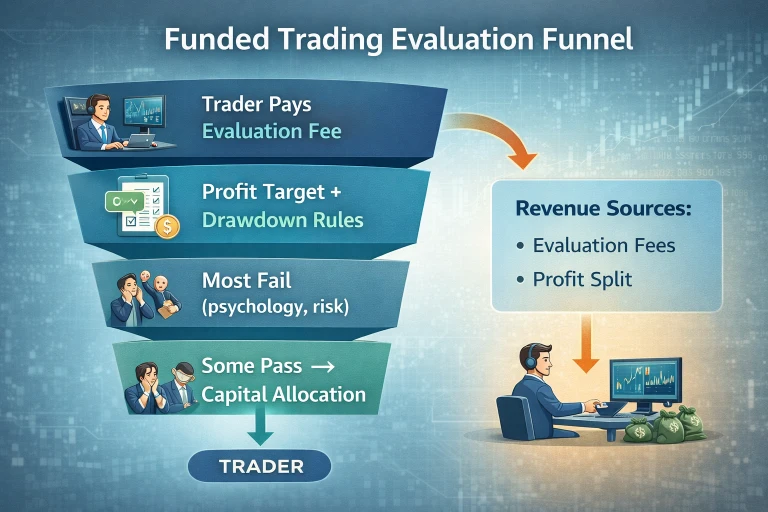
Because a large portion of traders fail due to psychological pressure, volatility mismanagement, or excessive position sizing, evaluation fees form a meaningful revenue source.
This is a business model — not a guarantee of unfairness.
What Happens After Passing?
Funded firms may operate in different ways:
- Some firms provide simulated trading environments where performance is tracked.
- Some firms allocate internal capital based on risk management frameworks.
- Some firms gradually scale trader allocations based on consistent performance.
Business models vary by firm, jurisdiction, and regulatory environment.
What Traders Should Learn
Funded trading is structured risk allocation.
Before paying evaluation fees, traders should carefully examine:
- Maximum drawdown rules.
- Profit targets and time limits.
- Payout structures and withdrawal policies.
- Execution conditions and platform stability.
If you are new to account types and capital access models, review How to Start Forex Trading Safely for Beginners: Demo vs Real vs Funded Accounts - Chapter 3 ( https://tradetogether.in/articles/start-forex-trading-safely-beginners-demo-real-funded ).
Risk discipline matters more than challenge marketing.
4. Why Most Retail Traders Lose (Structural Reality)
This topic is often misunderstood.
Retail trader loss rates are influenced by:
- Excessive leverage.
- Poor risk management.
- Emotional decision-making.
- Lack of position sizing discipline.
In a decentralized forex market, volatility during news events can magnify mistakes.
Practical Risk Example
If a trader risks 1% per trade:
- Losing streaks remain manageable and drawdowns stay relatively small.
- The trader has enough capital remaining to continue trading and recover gradually.
If a trader risks 8% per trade:
- A few consecutive losses can quickly create a large drawdown.
- Recovery becomes difficult because the remaining capital is significantly reduced.
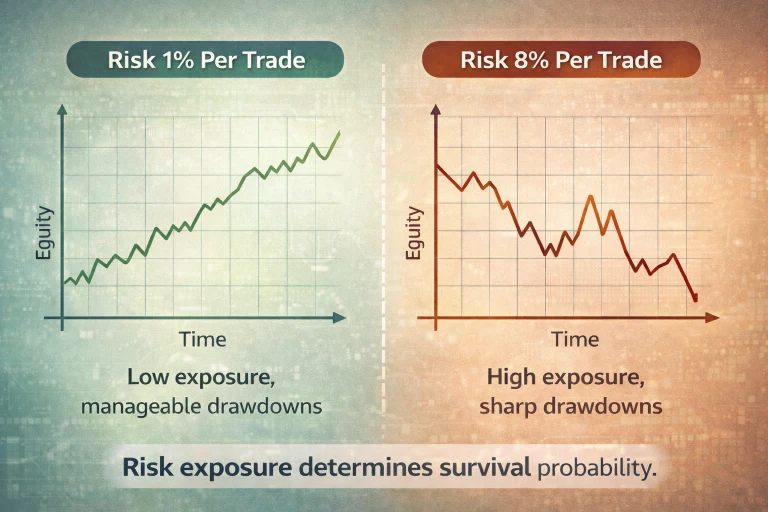
Risk exposure — not broker structure — determines survival probability.
5. Regulation and Transparency: What to Check
Before selecting a broker:
- Verify regulatory licensing and jurisdiction.
- Review client fund segregation policies.
- Understand execution models and order routing.
- Check fee transparency and spread disclosures.
For funded firms:
- Review evaluation rules carefully.
- Check payout history and trader feedback.
- Understand scaling plans and risk rules.
Regulation does not eliminate risk, but it improves accountability.
Frequently Asked Questions
1. Do all brokers send trades to the real market?
Not always. Some use internalization models, while others route trades externally. Many operate hybrid systems.
2. Is B-book execution illegal?
No. Internalization is common in financial markets. The key issue is transparency and regulatory compliance.
3. Do funded firms rely on failed challenges for revenue?
Evaluation fees are part of the business model. However, operational structures vary by firm.
4. Should traders avoid funded accounts?
Not necessarily. Funded accounts can provide capital access — but strict risk discipline is required.
5. How can traders reduce structural risk?
By choosing regulated entities, managing leverage conservatively, and focusing on probability-based decision-making.
Conclusion
Forex brokers and funded trading firms operate within structured business models shaped by the decentralized OTC nature of the currency market.
Understanding A-book vs B-book execution, evaluation fee models, and regulatory frameworks allows traders to approach the market with informed expectations.
However, long-term performance depends less on business model debates and more on disciplined risk management, capital preservation, and realistic position sizing.
This content is provided for educational purposes only and does not constitute financial advice.

Written by
Trade Together Research
Trade Together Research is a professional market analysis team providing forex, gold, and crypto trading insights, technical analysis, and educational guides.. Learn more about our research team on the About page.